
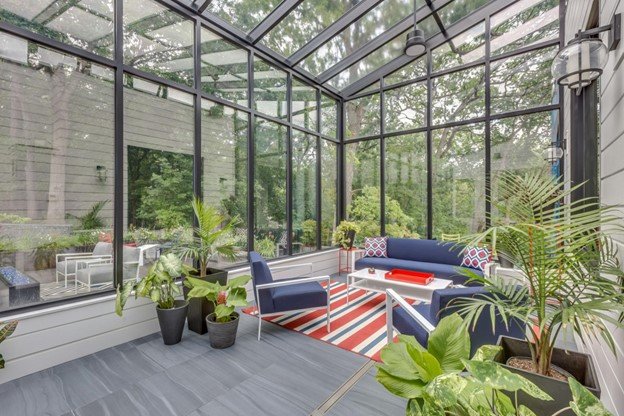
Sunroom flooring must survive conditions that standard indoor flooring never faces. Direct sunlight, amplified heat, and seasonal humidity create constant stress on materials. That is why the most reliable options remain UV-resistant luxury vinyl plank (LVP), porcelain tile, and sealed concrete. These materials do not just look good. They resist fading, handle expansion, and tolerate moisture without structural damage. The wrong choice leads to warping, bubbling, or discoloration within a short period, especially in sunrooms with large glass exposure and poor insulation balance.
The key difference is environmental behavior. Sunrooms act like controlled greenhouses where heat builds rapidly during the day and drops at night. Flooring expands, contracts, and absorbs moisture repeatedly. Materials like laminate or hardwood fail not because they are low quality, but because they are not built for this cycle. Your flooring decision must follow three factors: sunlight intensity from windows, insulation stability, and whether the room is 3-season or 4-season. Ignoring even one of these creates long-term structural problems and higher replacement costs.
Key performance requirements:
- UV resistance to prevent fading and surface breakdown
- Thermal stability to handle expansion and contraction
- Water resistance for humidity and condensation
- Surface comfort for seasonal usability
- Low maintenance for dust and moisture exposure
Why Sunroom Flooring Is Different From Regular Indoor Flooring
Sunroom flooring operates under a completely different stress environment compared to indoor flooring. Regular rooms maintain stable temperature and controlled light exposure. Sunrooms amplify sunlight through glass panels, increasing surface temperatures significantly. This heat penetrates flooring layers, causing expansion cycles that most materials are not designed to handle. Over time, this leads to visible damage such as buckling, gaps, or adhesive failure, especially in materials like laminate or low-grade vinyl.
Want to know what a sunroom is and how is it different from a normal room, refer to our expert complete sunroom guide to understand how flooring, layout, structure, lighting, and seasonal usability work together.
The interaction between windows and insulation is critical here. Large windows increase solar gain, while poor insulation allows rapid temperature swings. Together, they create a repeated stress cycle that weakens flooring structure. For example, laminate flooring may appear stable initially, but under continuous exposure, it begins to swell and separate at joints. This is why flooring selection cannot be isolated. It must align with the overall sunroom system, including glazing performance and insulation quality.
Why failure happens:
- Heat buildup from direct sunlight
- Rapid temperature fluctuation
- Moisture and condensation exposure
- Incompatible material structure
How Sunroom Type Changes Flooring Requirements (3-Season vs 4-Season)
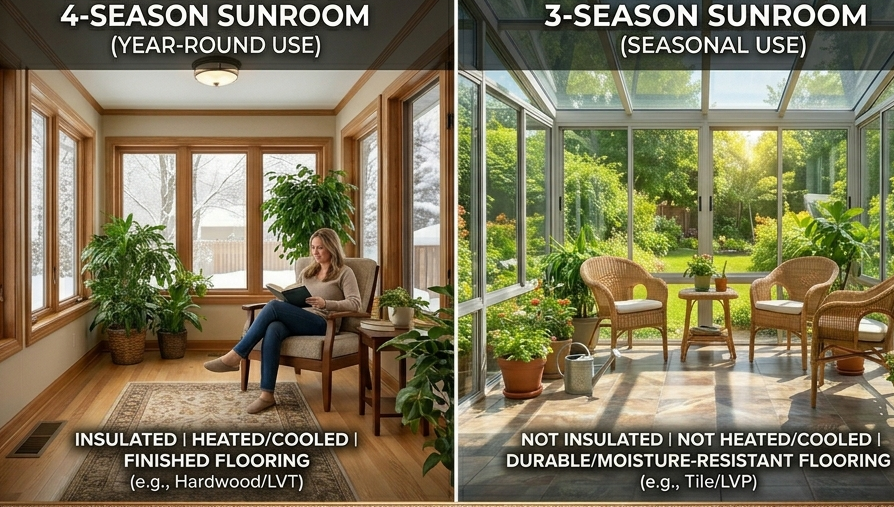
The type of sunroom directly determines flooring performance expectations. A 3-season sunroom behaves closer to an outdoor environment. It experiences humidity, condensation, and temperature swings because it lacks full climate control. Flooring here must prioritize water resistance and flexibility. Materials like vinyl plank and tile perform well because they can handle moisture and expansion without structural damage.
A 4-season sunroom is insulated and integrated with the home’s HVAC system. This creates a more stable environment, allowing a wider range of flooring options. However, stability does not eliminate risk. Sunlight exposure still creates localized heat zones, especially near windows. Engineered hardwood can work in these spaces, but only when installation is precise and environmental conditions are controlled. Even small fluctuations can lead to long-term issues if the material is not properly selected.
Understanding Sunroom Heating and Cooling is foremost important in order to select the correct flooring for you preferences, throughout the 3 Season or 4 Season System Requirements.
3-season vs 4-season flooring logic:
- 3-season → moisture-resistant, flexible materials
- 4-season → temperature-stable, comfort-focused materials
- Higher sunlight = stricter material requirements
- Insulation quality directly affects lifespan
| Flooring Type | 3-Season Sunroom | 4-Season Sunroom | Why |
| Vinyl Plank | ✅ Excellent | ✅ Excellent | Handles moisture + moderate heat |
| Tile | ✅ Excellent | ✅ Excellent | No expansion, high durability |
| Concrete | ✅ Excellent | ✅ Excellent | Stable and long-lasting |
| Laminate | ❌ Not Recommended | ⚠️ Conditional | Fails in humidity |
| Engineered Wood | ❌ Not Recommended | ⚠️ Conditional | Needs stable climate |
Flooring decisions only make sense when aligned with the overall sunroom structure. If you have not defined whether your space is a 3-season or 4-season sunroom, material selection becomes guesswork. Start with a complete understanding of how sunrooms are designed, insulated, and exposed to the environment, then return to flooring selection with that clarity.
What Makes Flooring Suitable for Sunrooms
The suitability of flooring in a sunroom depends on performance, not appearance. Materials must withstand continuous exposure to sunlight, temperature changes, and humidity without degrading. UV resistance is the first requirement because sunlight breaks down surface layers over time. Without protection, flooring fades unevenly, especially in areas near windows where exposure is highest.
Thermal stability is equally important. Flooring expands when heated and contracts when cooled. Materials that cannot handle this movement begin to crack or separate. Water resistance adds another layer of protection, particularly in 3-season sunrooms where condensation is common. Surface behavior also matters. Some materials become too hot in summer or too cold in winter, affecting usability. A good flooring system balances durability, comfort, and maintenance without compromising structure.
Surface temperature directly affects usability. Tile and concrete absorb and retain heat, making them extremely hot under direct sunlight. In winter, these same materials become cold and uncomfortable without insulation or heating systems. Vinyl flooring performs better in this regard, maintaining a more neutral surface temperature across seasons.
Core performance criteria:
- UV resistance for color stability
- Expansion tolerance for heat cycles
- Moisture resistance for humidity control
- Comfortable surface temperature
- Easy maintenance for long-term use
Best Flooring Materials for Sunrooms (Performance-Based Breakdown)
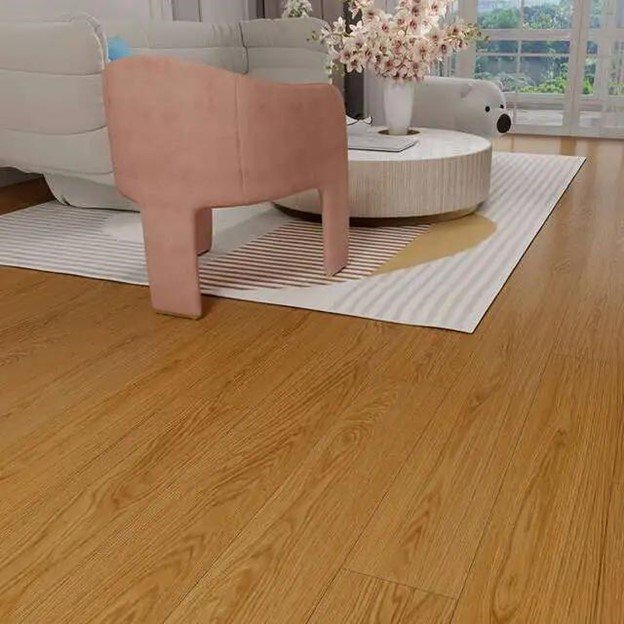
Luxury vinyl plank remains the most balanced option for most sunrooms. It is waterproof, flexible, and capable of handling moderate temperature changes. High-quality versions include UV-stabilized layers that reduce fading. However, proper installation is critical. Without expansion gaps, even vinyl can buckle under heat pressure. Real-world cases show vinyl failing not because of material weakness, but due to incorrect installation.
Porcelain tile offers unmatched durability. It does not expand, fade, or absorb moisture, making it ideal for high-sunlight environments. Sealed concrete provides similar benefits with a modern aesthetic and minimal maintenance. Laminate and engineered hardwood sit on the lower end of performance. They can work in controlled environments, but they require strict conditions. Any variation in humidity or temperature reduces their lifespan significantly.
Material performance summary:
- Vinyl plank → best balance of flexibility and durability
- Tile → highest resistance to heat and sunlight
- Concrete → long-term stability with minimal upkeep
- Laminate → budget option with environmental limits
- Engineered wood → only for controlled 4-season use
| Flooring Type | UV Resistance | Water Resistance | Expansion Risk | Surface Heat | Lifespan | Best For |
| Vinyl Plank (LVP) | High | 100% | Medium (needs gaps) | Low–Moderate | 10–20 yrs | Most sunrooms (balanced choice) |
| Porcelain Tile | Very High | 100% | None | High (can get hot) | 30+ yrs | High sunlight exposure |
| Sealed Concrete | Very High | High (sealed) | None | High | 30+ yrs | Modern sunrooms on slab |
| Laminate | Medium | Low | High | Moderate | 5–10 yrs | Low sunlight, 4-season only |
| Engineered Wood | Medium | Low–Medium | Medium–High | Moderate | 10–20 yrs | Climate-controlled sunrooms |
While this guide explains how each flooring type performs in a sunroom environment, choosing between specific materials often requires deeper comparison. For example, vinyl and tile behave very differently under heat and moisture, and each has trade-offs depending on your setup. Exploring focused comparisons and condition-specific guides will help you make a more precise decision.
Flooring Materials to Avoid in Sunrooms
Certain materials consistently fail in sunroom environments regardless of quality. Solid hardwood is the most common mistake. It expands and contracts significantly under heat and humidity, leading to warping and cracking. Even with proper sealing, it cannot handle the constant environmental stress of a sunroom. Many homeowners install hardwood for aesthetics, only to replace it within a few years due to structural damage.
Carpet is another unsuitable option. It absorbs moisture from the air, creating a breeding ground for mold and odors. In sunrooms with high humidity, this becomes a persistent issue that affects both comfort and hygiene. These materials fail not because they are poorly made, but because they are incompatible with the environmental conditions of a sunroom.
Avoid these materials:
- Solid hardwood due to expansion and warping
- Carpet due to moisture retention and mold risk
- Low-grade laminate in high humidity
- Non-UV-resistant vinyl products
Sunroom Flooring Over Concrete vs Wood Subfloor
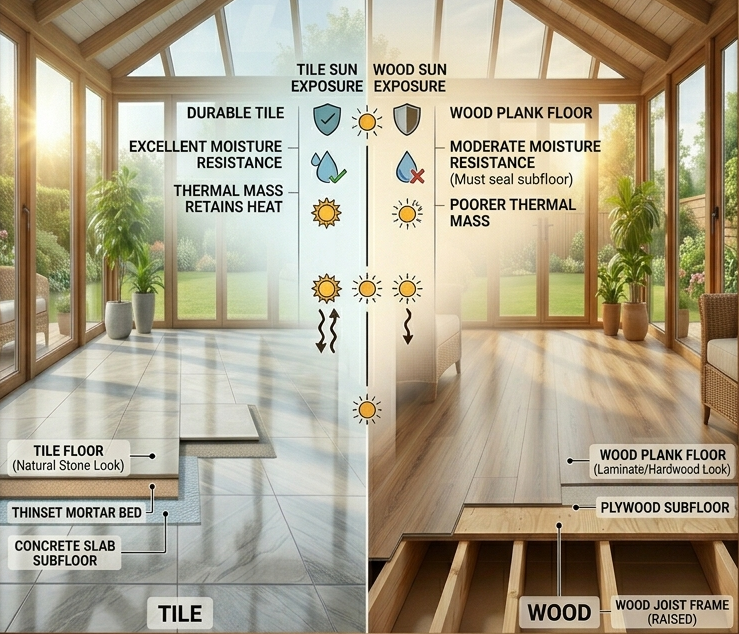
Subfloor type plays a decisive role in flooring performance. Concrete subfloors provide a stable, moisture-resistant base that works well with tile, vinyl, and polished concrete finishes. However, moisture barriers may still be required depending on the climate. Ignoring this step can lead to hidden moisture issues that damage flooring from below.
Wood subfloors introduce additional complexity. They expand and contract with humidity, requiring floating floor systems and expansion gaps. Installation precision becomes critical because even small errors can lead to structural problems. Many flooring failures occur not because of the surface material, but because the subfloor was not properly considered during installation.
Subfloor considerations:
- Concrete → stable, ideal for tile and vinyl
- Wood → requires floating systems and flexibility
- Moisture barriers are essential in humid climates
- Subfloor mistakes lead to early failure
| Subfloor Type | Best Flooring Options | Risk Level | Key Requirement |
| Concrete | Tile, Vinyl, Concrete | Low | Moisture barrier |
| Wood | Vinyl (floating), Engineered Wood | Medium | Expansion gaps |
| Uneven Base | Vinyl, Floating Systems | High | Leveling required |
How Sunlight and Windows Affect Flooring Performance
Sunlight exposure directly impacts how flooring behaves over time. Large windows increase UV radiation and heat buildup, especially in south-facing sunrooms. This accelerates fading and expansion, particularly in sensitive materials like laminate. Even high-quality flooring can degrade if it is not designed for continuous exposure to sunlight.
Heat concentration near windows creates uneven stress across the floor. Areas closer to glass surfaces expand more than shaded areas, leading to tension within the material. Over time, this causes visible damage such as gaps or lifted edges. Flooring must therefore be selected with full awareness of window orientation and solar exposure levels.
The amount of heat and UV exposure your flooring receives is directly controlled by your window system. Glass type, coatings, and orientation determine how much solar energy enters the room. Choosing flooring without understanding window performance often leads to fading and overheating issues. A detailed breakdown of glazing types and solar control can help you predict how your flooring will behave long-term.
The amount of sunlight, UV exposure, and temperature fluctuation your floor experiences depends heavily on the type of sunroom windows installed. Different window systems can directly impact flooring durability and fading resistance. Explore sunroom windows guide for a comprehensive point of understanding as to our it affects the overall efficiency of a sunroom.
Impact of sunlight:
- Increased surface temperature
- Accelerated fading and discoloration
- Uneven expansion across the floor
- Higher stress near window zones
How Insulation Impacts Flooring Lifespan
Insulation stabilizes the environment, reducing the stress placed on flooring materials. A well-insulated sunroom maintains consistent temperatures, minimizing expansion and contraction cycles. This significantly extends the lifespan of materials like vinyl, tile, and even engineered wood. Without insulation, flooring is exposed to extreme variations that weaken its structure over time.
Temperature stability also improves comfort. Floors remain usable throughout the year instead of becoming too hot in summer or too cold in winter. Insulation works as a protective layer, not just for the room, but for the flooring system itself. Investing in insulation often reduces long-term flooring costs by preventing premature replacement.
Insulation benefits:
- Reduces temperature fluctuation
- Extends flooring lifespan
- Improves comfort across seasons
- Prevents structural stress
Flooring durability is directly tied to how well the sunroom is insulated. Without proper insulation, temperature swings increase expansion cycles and reduce material lifespan. Insulation controls not only comfort but also structural stability of flooring systems. Understanding insulation types and thermal control strategies is essential before committing to any flooring material. Thus, study our sunroom insulation expert insight into how it effects the different metrics inside a sunroom.
Cost of Sunroom Flooring (Material + Installation)
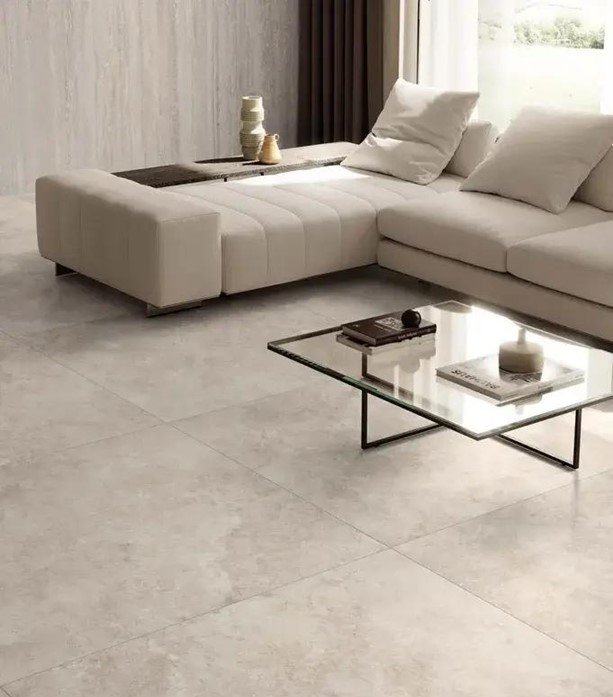
Flooring costs vary based on material, installation complexity, and durability. Vinyl plank offers an affordable entry point with strong performance, while tile and concrete require higher initial investment but deliver longer lifespans. The real cost is not just the purchase price, but how long the material lasts under sunroom conditions.
Cheaper materials often fail sooner, leading to replacement costs that exceed the price of durable options. For example, laminate may cost less upfront, but if it needs replacement within five years, it becomes more expensive than tile over time. A cost-effective decision considers both initial expense and long-term performance.
Typical cost ranges:
- Vinyl plank → $3–$7 per sq ft
- Tile → $5–$15 per sq ft
- Concrete → $4–$10 per sq ft
- Laminate → $2–$6 per sq ft
| Flooring Type | Avg Cost (per sq ft) | Installation Cost | Lifespan | Replacement Risk | Long-Term Value |
| Vinyl Plank | $3–$7 | Low–Moderate | 10–20 yrs | Medium | High |
| Tile | $5–$15 | High | 30+ yrs | Low | Very High |
| Concrete | $4–$10 | Moderate | 30+ yrs | Very Low | Very High |
| Laminate | $2–$6 | Low | 5–10 yrs | High | Low |
| Engineered Wood | $6–$12 | High | 10–20 yrs | Medium | Medium |
Common Sunroom Flooring Mistakes
Most flooring issues are caused by incorrect decisions rather than material defects. One of the most common mistakes is ignoring expansion gaps during installation. Without space to expand, materials like vinyl and laminate push against each other, leading to buckling. Another frequent issue is installing laminate in high-humidity environments where it cannot perform.
Homeowners also underestimate the impact of sunlight. Flooring placed near large windows experiences higher stress, which must be accounted for during selection and installation. Skipping moisture barriers on concrete subfloors is another major error that leads to hidden damage over time.
A common real-world failure occurs when vinyl plank flooring is installed tightly against walls without expansion gaps. In sunrooms with strong sunlight, the material expands during the day and has nowhere to move. This pressure causes the floor to lift or buckle within months, even when high-quality materials are used. Most failures are not material defects, but installation mistakes.
Common mistakes:
- No expansion gaps during installation
- Choosing materials based on appearance only
- Ignoring sunlight exposure levels
- Skipping moisture protection layers
| Mistake | What Happens | Timeframe of Failure |
| No expansion gap | Buckling / lifting floor | 2–6 months |
| Using laminate in humidity | Swelling, bubbling | 3–12 months |
| Ignoring UV exposure | Fading, discoloration | 6–18 months |
| No moisture barrier | Hidden water damage | 6–24 months |
| Installing hardwood in 3-season | Warping and cracking | 6–12 months |
Expert Checklist: How to Choose the Right Sunroom Flooring
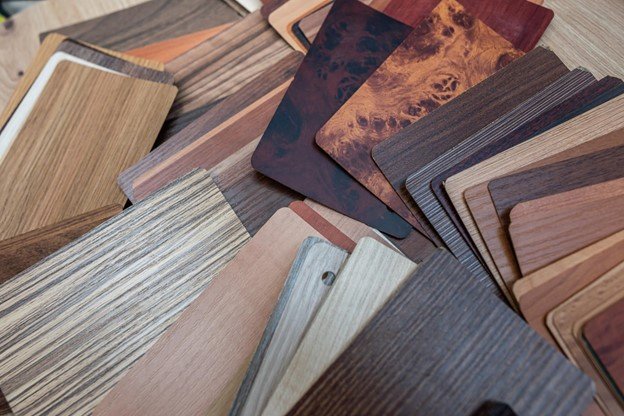
Choosing the right flooring requires a structured decision process. Start by evaluating how much sunlight enters the room and how stable the temperature remains throughout the year. Then consider the type of subfloor and the level of moisture exposure. These factors determine which materials can perform reliably over time.
Budget should be evaluated alongside lifespan, not separately. A cheaper option that fails early is not cost-effective. The goal is to select flooring that aligns with environmental conditions and delivers long-term stability. This approach reduces maintenance, prevents damage, and ensures consistent performance.
Decision checklist:
- Sunlight intensity and window exposure
- Insulation level and temperature stability
- Subfloor type and condition
- Moisture levels in the room
- Budget vs long-term durability
| Your Condition | Best Flooring Choice |
| High sunlight | Tile or UV-resistant vinyl |
| High humidity | Vinyl plank |
| Concrete base | Tile or concrete finish |
| Budget-friendly | Vinyl plank |
| Long-term durability | Tile or concrete |
Professional installers prioritize expansion tolerance over appearance in sunrooms because most flooring failures are caused by movement, not surface wear. Materials that can flex and adjust to environmental changes consistently outperform rigid systems in long-term performance.
FAQs
What is the best flooring for a sunroom with lots of sunlight?
Vinyl plank and porcelain tile are the most reliable because they resist UV damage and heat.
Does vinyl flooring warp in heat?
High-quality vinyl expands but does not warp if installed with proper expansion gaps.
Can you put hardwood flooring in a sunroom?
Only in insulated, climate-controlled sunrooms. Otherwise, it will warp and crack.
What is the cheapest durable flooring option?
Vinyl plank offers the best balance between cost and durability.
Is tile too cold for a sunroom?
Tile can feel cold, but insulation or underfloor heating improves comfort.
Does laminate flooring fade in sunlight?
Yes, especially under direct exposure, making it less suitable for sunrooms.












0 Comments