
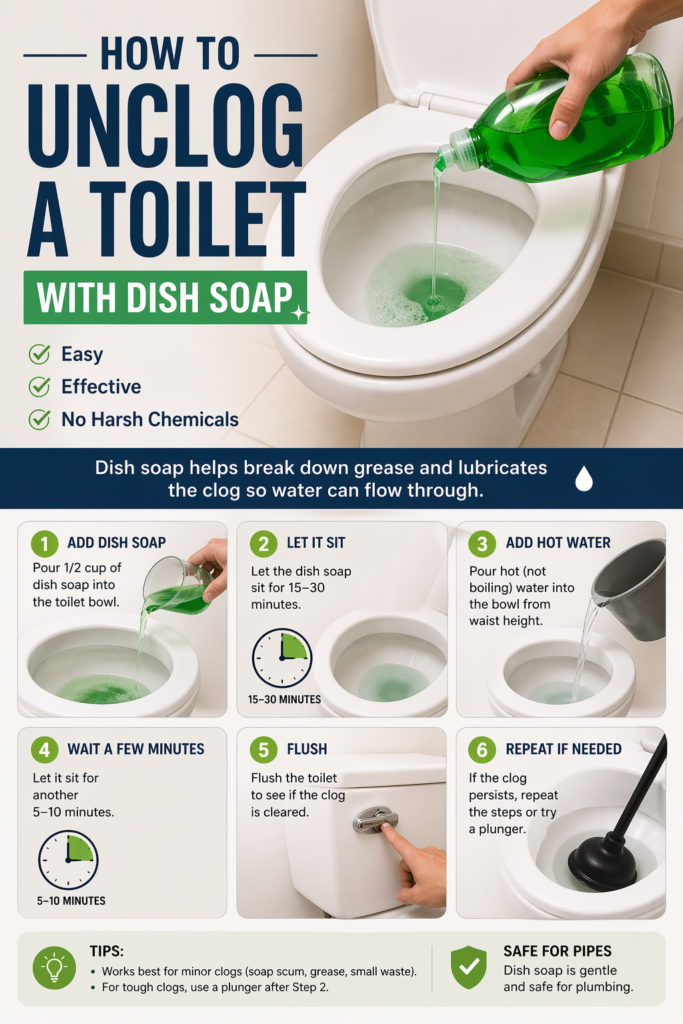
Yes, dish soap can help unclog a toilet when the blockage is soft, minor, and close enough to loosen with lubrication and hot water. The safest method is to add dish soap, wait several minutes, pour in hot but not boiling water, and flush only when the bowl level looks stable. This is a first-response fix, not a solution for severe blockages or foreign objects. This
Can dish soap actually unclog a toilet?
Dish soap can help unclog a toilet when the blockage is soft, minor, and not caused by a solid object.
Dish soap can work because it reduces friction around the clog and helps soften or lubricate material that is stuck in the trap. That is why many DIY guides recommend it for minor toilet paper clogs or soft organic blockages, especially when you do not have a plunger nearby. It is not magic, though. It works best when the clog is partial, not when the toilet is packed with wipes, dense paper mass, or a solid object.
In real homes, this method is most useful in the awkward middle situation where the toilet is not fully overflowing but clearly not draining correctly. The bowl still holds water, the flush is weak, and you want a low-risk fix before turning the problem into a mess. That is the right mindset for this method. Treat it like a smart first step, not a guaranteed cure. If the water keeps rising or the bowl is already near the rim, control the overflow risk first instead of flushing again.
When Should You Try Dish Soap First?
Dish soap is worth trying first when the clog is fresh, the toilet still drains a little, and the blockage is likely caused by toilet paper or soft waste rather than a solid object. Current home-repair and plumber-backed guidance consistently treats the soap-and-hot-water method as a safer first move for minor clogs, especially when a plunger is not available. It is not designed for every situation, but it is one of the lowest-risk ways to test whether the blockage can loosen without force.
- Try dish soap first when the clog is recent
- Try it when the toilet still drains slowly instead of not at all
- Try it when the blockage is likely toilet paper or soft waste
- Skip it when wipes, toys, or other objects may be lodged
- Skip it when the toilet backs up repeatedly
Do not rely on it when
- A toy, wipe, pad, or other object may be stuck
- The toilet is backing up repeatedly
- Water is already close to overflowing
- Multiple fixtures in the home are draining badly
This method is consistently recommended as a minor-clog fix, while deeper or harder blockages are better handled with a plunger, auger, or plumber.
What If the Toilet Bowl Is Already Full?
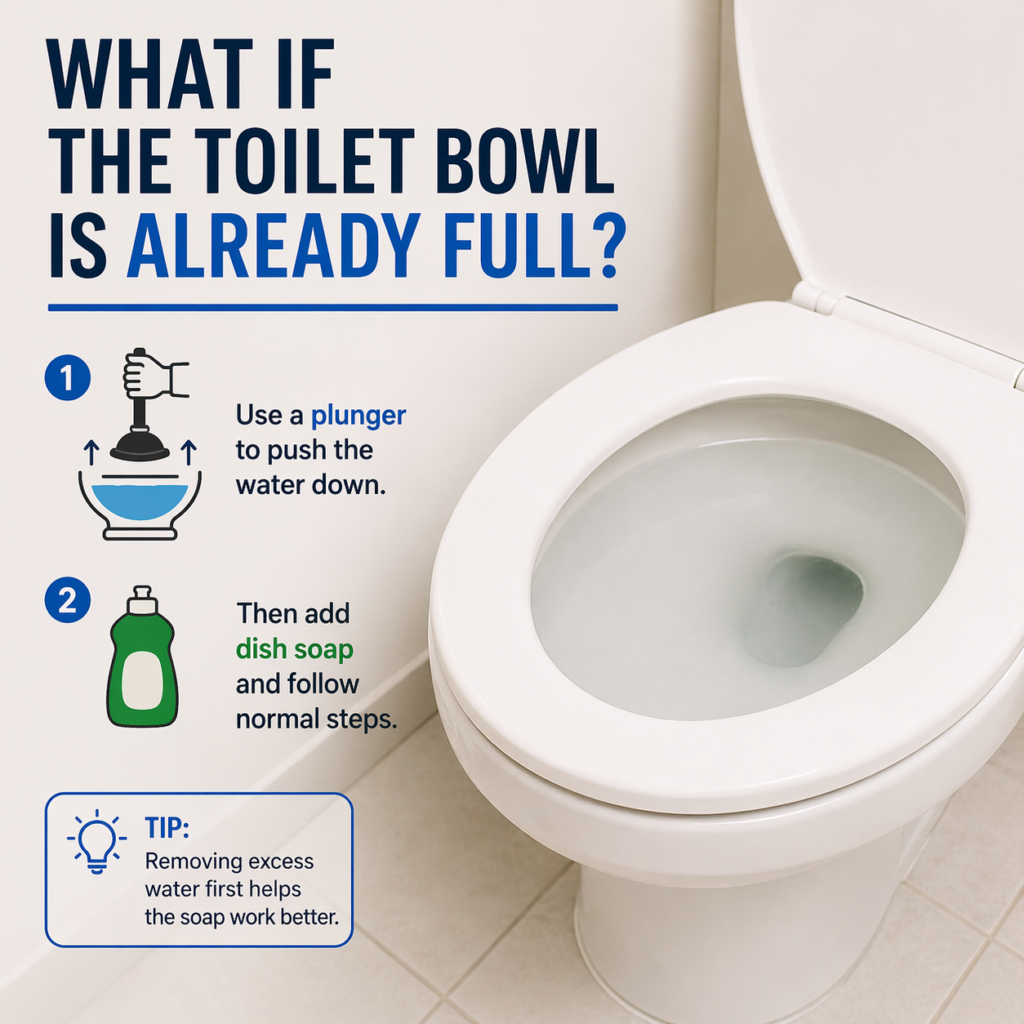
If the toilet bowl is already full, do not flush again. That is the most important first move because another flush can turn a simple clog into an overflow problem. Overflow guidance consistently recommends shutting off the water at the toilet’s shutoff valve if the level keeps rising. If the bowl is high but stable, let the water settle before adding anything. When you do use the dish soap method, pour slowly and avoid dumping in too much hot water at once.
- Do not flush again while the bowl is high
- Turn off the shutoff valve if water keeps rising
- Wait for the water level to settle if possible
- Add soap gently, not aggressively
- Pour hot, not boiling, water only when the bowl looks stable
Why does dish soap help loosen a toilet clog?
Dish soap helps by lubricating the trapway and reducing friction around soft material stuck in the drain path.
The core reason is lubrication. Dish soap coats the surfaces inside the trapway and around the clog, which can help stuck material slide through more easily once hot water is added. Some guides also describe it as helping soften the blockage enough to get things moving again. The method is simple, but the logic matters because it tells you what kind of clog it is meant for. It is not dissolving a hard object. It is assisting movement in a tight, slippery space.
That is why decision clarity matters more than the hack itself. If the clog was caused by too much toilet paper, a heavy flush, or a soft waste buildup, dish soap has a fair chance. If someone flushed wipes, paper towels, hygiene products, or a child’s object, lubrication alone usually will not solve the problem. Readers often fail with this method not because it is useless, but because they apply it to the wrong blockage. Good DIY advice should separate soft clogs from structural or foreign-object problems before the first step even begins.
What dish soap can help with
- Soft toilet paper buildup
- Organic waste clogs
- Partial blockages near the trap
- No-plunger emergency situations
What dish soap usually cannot fix
- Flushable wipes
- Plastic items or toys
- Dense long-standing blockages
- Sewer line or recurring drain problems
This is why the method belongs in a wider unclogging decision system, not as a one-size-fits-all answer.
How to unclog a toilet with dish soap step by step
Add dish soap first, wait a few minutes, pour in hot non-boiling water, and flush only when the bowl level looks stable.
Start by checking the water level. If the bowl is already too full, do not flush again. Add dish soap directly into the bowl and let it sink toward the drain. Current DIY guidance varies on quantity, but the common range is about 1/4 cup to 1 cup, depending on the source and the severity of the clog. Then wait long enough for the soap to reach the blockage. Guidance commonly recommends anywhere from 5 to 30 minutes before the next step.
After the waiting period, pour in hot, not boiling, water. This is one of the most important safety points in the whole article. Several current sources warn against boiling water because it can crack porcelain or damage PVC-related plumbing components. Pour the hot water steadily, not aggressively, and give the bowl a moment to settle. If the water level drops or the bowl looks more stable, try one careful flush. If it rises again, stop there and move to the next tool rather than forcing another flush.
Step-by-step process
- Add dish soap to the bowl
- Wait 5 to 30 minutes
- Pour in hot, non-boiling water
- Watch the bowl level before flushing
- Flush once, carefully
- Escalate if there is no improvement
Quick decision rule
- Bowl level drops = the method is helping
- Bowl level stays the same = clog may still be partially stuck
- Bowl level rises = stop and switch methods
These time ranges and safety steps match current guidance from major home-repair and plumbing-adjacent sources.
How long should you wait, and what result should you expect?
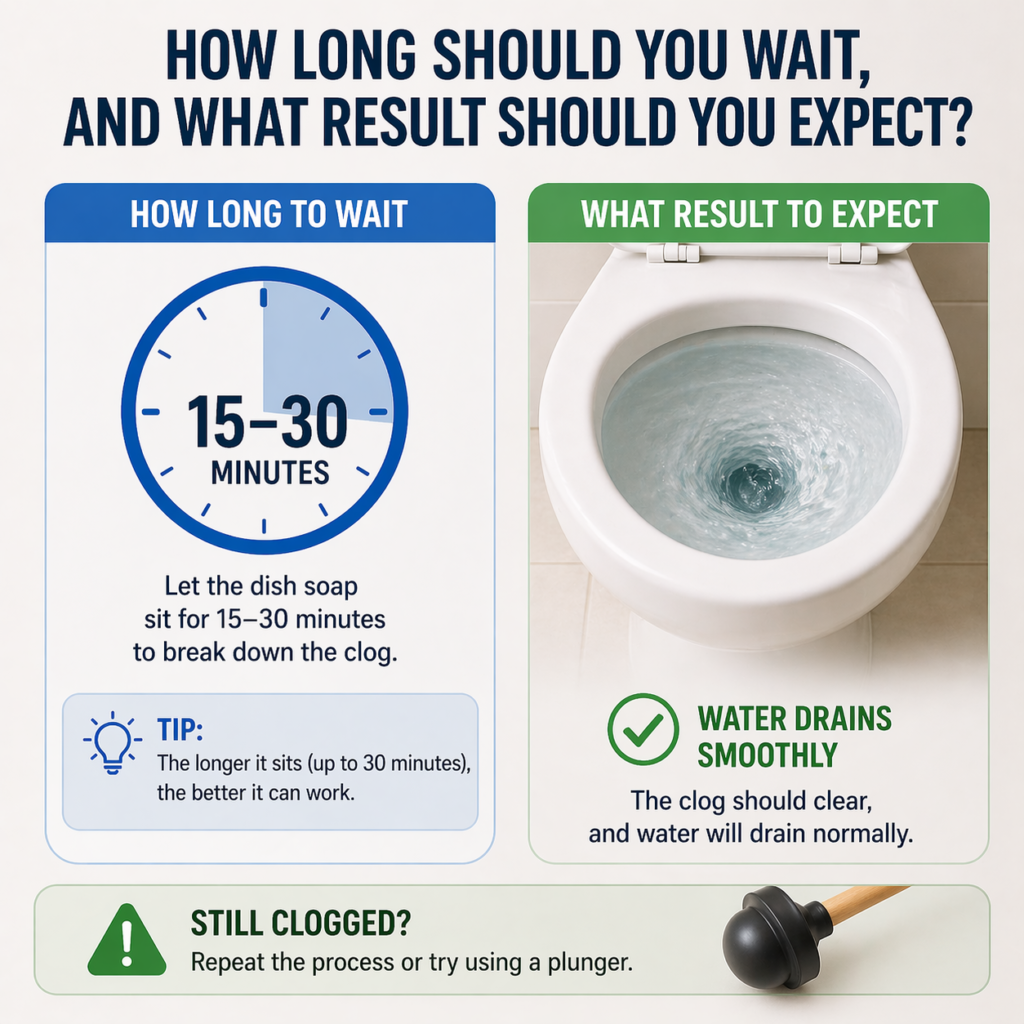
Most minor soft clogs show improvement within 5 to 30 minutes if the method is going to work.
One weakness in most competing content is that it tells readers what to do but not what success should actually look like. Dish soap is not a “seconds” fix in most cases. Current guidance usually suggests waiting at least a few minutes, with many sources landing between 5, 10, 15, and 30 minutes depending on the version of the method. That tells us something important. The method works by gradually improving movement around the clog, not by breaking it apart instantly.
In practice, success often appears in stages. First, the bowl may stop looking tense or overfilled. Then the water may slowly lower. Only after that should you expect a cleaner flush. If you try once and nothing changes, a second attempt may still be reasonable if the water level is safe and the clog is likely soft. But if there is zero movement after one or two careful rounds, that is your decision point. At that stage, more waiting usually does not add much value. A plunger or toilet auger becomes the better next step.
Realistic time expectations
- Light soft clog: 5 to 10 minutes
- Moderate soft clog: 10 to 30 minutes
- No change after 1 to 2 attempts: switch methods
- Repeated overflow risk: stop DIY flushing
| Clog situation | Dish soap likely to help | Best next move |
| Mild toilet paper clog | High | Dish soap + hot water |
| Soft organic blockage | Medium to high | Dish soap, then careful flush |
| Wipes or hygiene product | Low | Toilet auger |
| Suspected foreign object | Very low | Auger or plumber |
| Repeated recurring clog | Low | Professional inspection |
The decision point matters more than the exact minute count. Good DIY results come from knowing when to stop.
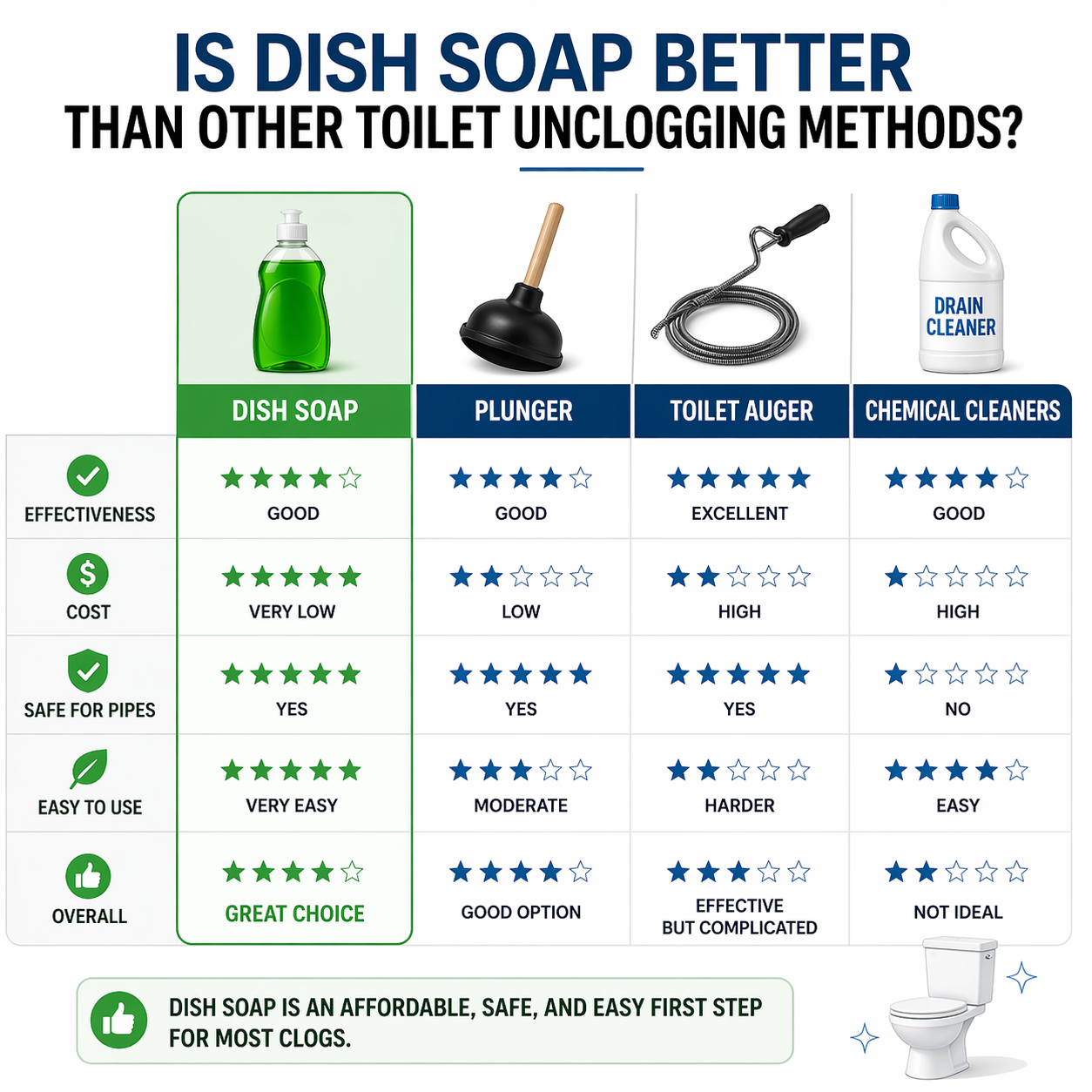
Is Dish Soap Better Than Other Toilet Unclogging Methods?
Dish soap is not the strongest toilet-unclogging method, but it is often one of the safest first methods for a soft clog. Current guidance positions plunging as the quickest and most effective solution for many standard toilet clogs, while a toilet auger is the better step when the blockage sits deeper in the trap or resists plunging. Dish soap fits earlier in the decision chain because it can loosen minor buildup without force, scratching, or harsh chemicals. That makes it useful, but only within the right limits.
| Method | Best For | Strength |
| Dish soap + hot water | Minor soft clogs | Low-risk first step |
| Plunger | Most standard clogs | Fastest next tool |
| Toilet auger | Deeper tough clogs | Stronger escalation |
| Plumber | Repeated or severe issues | Best for persistent problems |
Real-World Example of When the Dish Soap Method Makes Sense
A practical example helps readers understand the method better than theory alone. Imagine a toilet that clogged right after a heavy toilet paper flush. The bowl is high, but not yet overflowing, and there is no plunger nearby. This is the kind of situation where dish soap makes sense as a first-response fix. The likely blockage is soft, recent, and still close enough to respond to lubrication and hot water. In many similar DIY guides, that is exactly the type of clog the method is meant for.
Now imagine the outcome. The soap goes in first, the water is allowed to settle, and hot non-boiling water is poured in slowly. After waiting, the bowl level begins to lower slightly. That small change is the signal that the method is working. If nothing changed at all, the next smart step would be a plunger, not endless repetition. The lesson is simple. Dish soap works best when the clog is soft, recent, and clearly not caused by a wipe, toy, or another solid object.
- Best case for this method is a fresh soft clog
- Early bowl-level movement is a positive signal
- No movement means the next tool should change
- Solid objects usually require escalation faster
What should you not do when using this method?
Do not use boiling water, panic flush a full bowl, or keep repeating the method when there is no visible progress.
The biggest mistake is panic flushing. If the bowl is already high, another flush can turn a manageable clog into a bathroom cleanup emergency. The second mistake is using boiling water. Several current home-repair sources explicitly warn that boiling water can crack the porcelain or harm plumbing materials, which turns a cheap fix into an expensive repair. The third mistake is assuming this method can solve every type of blockage. It cannot.
Another common error is pouring too aggressively or working too fast. The dish soap method works best when the soap has time to move downward and the added hot water is controlled. Dumping water too quickly can raise the level before the soap has done anything useful. Readers also underestimate the importance of stopping when the signals are wrong. If the toilet makes no progress, backs up again, or has a history of recurring clogs, the problem may be deeper than a single soft blockage. That is not the moment to keep experimenting. That is the moment to change tools.
Do not do these things
- Do not use boiling water
- Do not flush repeatedly while water is high
- Do not assume wipes behave like toilet paper
- Do not keep repeating the method with no progress
- Do not ignore signs of a deeper plumbing problem
Watch for these red flags
- Gurgling or repeated backups
- Water rising close to the rim
- Slow drainage after multiple attempts
- Other nearby drains acting up too
These warnings line up with current DIY and plumber-backed guidance on safe toilet unclogging.
When should you use a plunger, a toilet auger, or call a plumber?
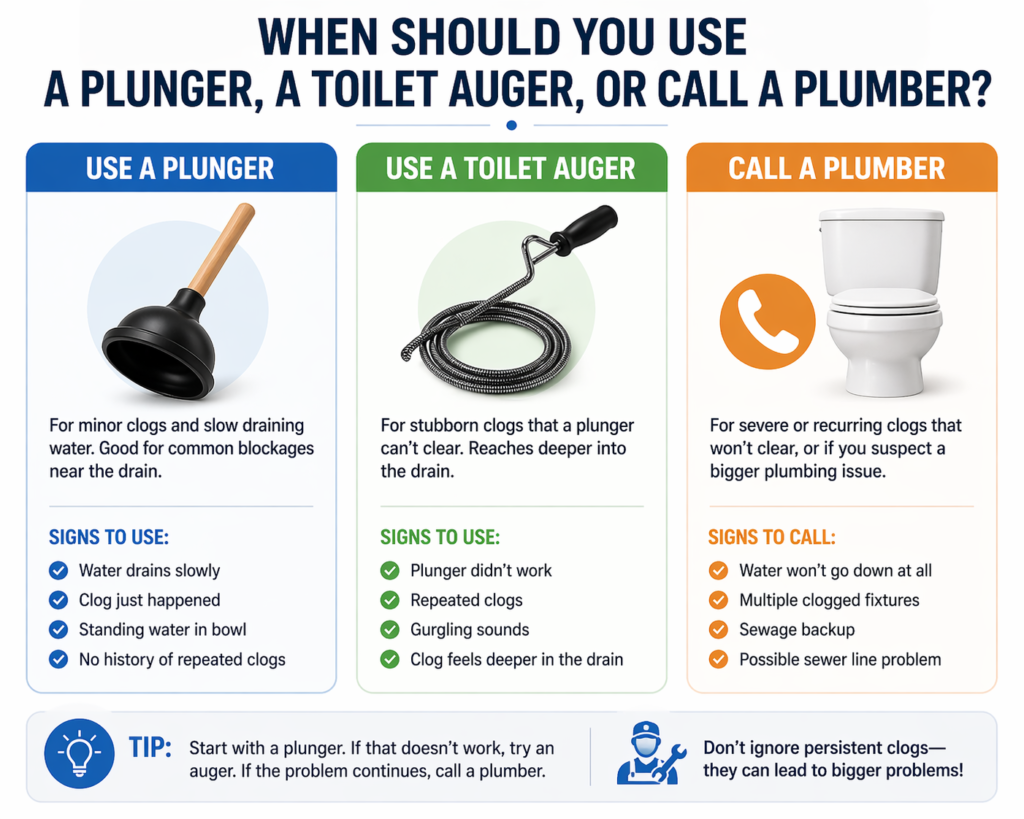
Use a plunger for standard clogs, a toilet auger for deeper resistance, and a plumber for repeated or severe blockage.
A plunger is usually the next step when dish soap does not produce visible improvement. If the clog is still close enough to respond to pressure, plunging can finish what the lubrication started. A toilet auger is the better choice when the blockage feels deeper, tougher, or physically stuck. Current plumber-backed guidance highlights the toilet auger as one of the most effective and toilet-safe tools for deeper clogs because it is designed specifically for the shape of the toilet trap.
A plumber becomes the right call when the problem stops looking like a one-off clog. That includes repeated blockages, signs of sewage backup, multiple slow drains, or any suspicion that something solid has been flushed and lodged inside. This is where many DIY articles stay vague, but readers need a firm threshold. Home maintenance content performs better when it removes hesitation. If the method failed cleanly, you use another tool. If the situation looks bigger than one toilet bowl, you stop treating it as a bowl-only issue.
Choose your next step like this
- Dish soap failed, but bowl is stable → use a plunger
- Clog feels deeper or repeated → use a toilet auger
- Object may be stuck → skip the soap retry and escalate
- Multiple fixtures are affected → call a plumber
- Overflow or sewage signs appear → call a plumber immediately
This tool progression matches the safest path from light DIY to deeper intervention.
How can you prevent toilet clogs in the future?
Most toilet clogs are prevented by flushing only waste and toilet paper and avoiding oversized paper loads.
Prevention is less about tricks and more about flush discipline. The simplest rule is still the most effective one: only flush human waste and toilet paper. Current guidance on no-plunger alternatives and toilet clog prevention repeatedly points back to excessive paper use and inappropriate items as the most common causes of clogs. That matters because most readers do not need a better hack. They need better prevention habit.
The real-world fix is to reduce the conditions that make emergency methods necessary. Encourage smaller paper loads, teach children what not to flush, and pay attention to recurring weak flushes. A toilet that clogs often may not just be dealing with user behavior. It may have a developing trap issue, partial blockage, or low-flush performance problem that needs a different solution. Smart home advice should always separate accidental misuse from repeat system weakness, because the long-term answer is not more dish soap. There are fewer clog triggers and faster escalation when the pattern changes.
Prevention checklist
- Flush only waste and toilet paper
- Avoid oversized paper loads
- Never flush wipes, towels, or hygiene products
- Watch for repeated slow flush behavior
- Act early before a partial clog becomes a full blockage
This closing section helps the page rank for preventive intent while strengthening topical authority around toilet-clog troubleshooting.
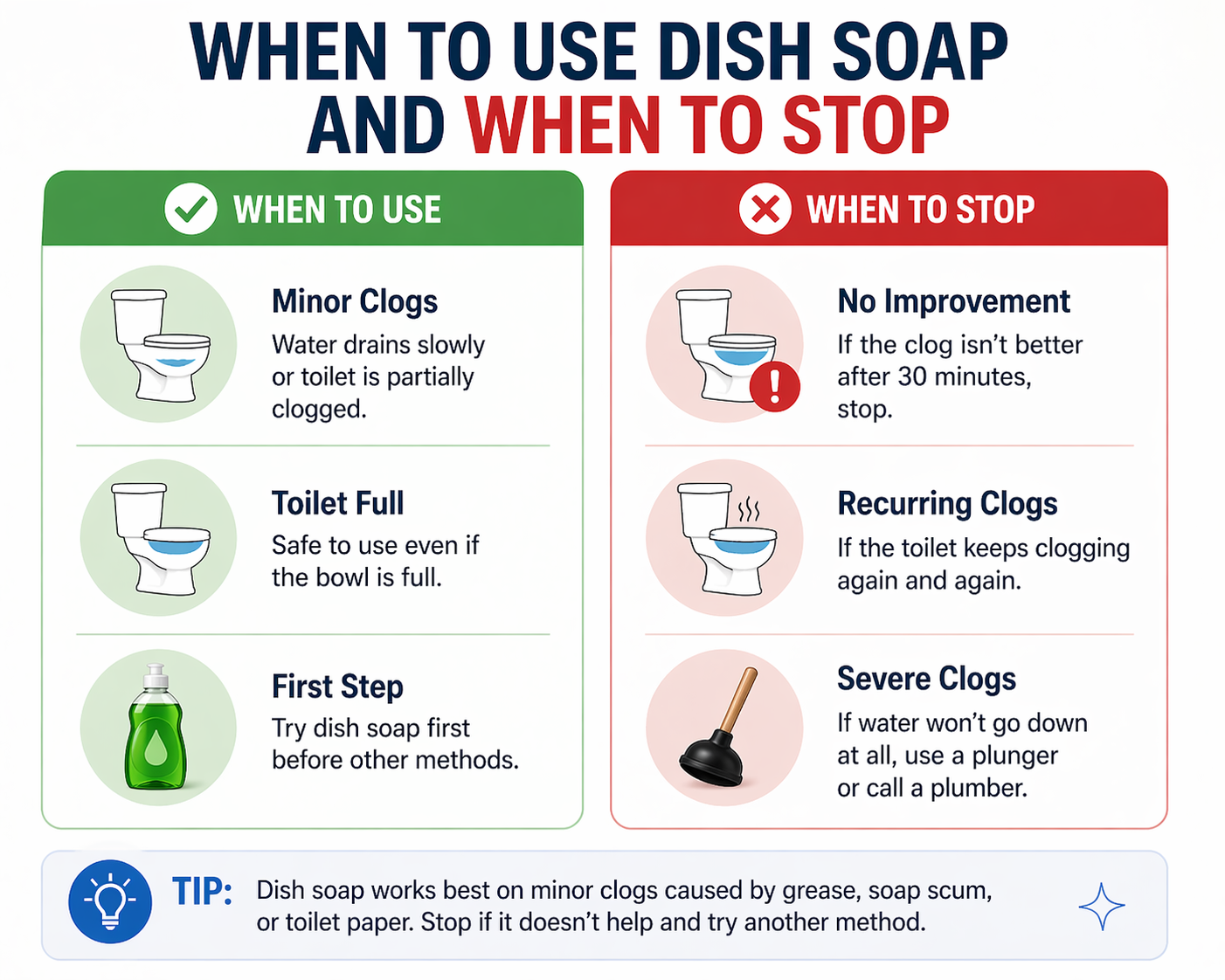
When to Use Dish Soap and When to Stop
Dish soap is a smart first method when the clog is minor, soft, and recent, especially if the toilet still drains a little and you do not have a plunger in hand. Current guidance supports using soap with hot, not boiling, water because the combination can help lubricate and loosen soft material while staying gentler than harsh chemical options. The value of this method is not that it works on every clog. The value is that it helps you test a likely soft blockage with low risk before moving to stronger tools.
The stopping point is just as important as the starting point. If the bowl level stays high, the clog keeps returning, or the toilet shows no improvement after one or two careful attempts, the method has already told you what you need to know. It is time to switch to a plunger, a toilet auger, or a plumber depending on the severity. That decision clarity is what turns a simple DIY page into genuinely helpful home advice.
- Use dish soap for soft, likely paper-based clogs
- Use hot water, never boiling water
- Stop if the bowl level rises or nothing changes
- Escalate faster for deep, repeated, or object-related clogs
FAQ Section
Can dish soap unclog a toilet without a plunger?
Yes, it can help with a minor soft clog by lubricating the blockage and improving movement when followed with hot, non-boiling water. It is most useful as a first-response method, not a guaranteed fix for severe clogs.
How much dish soap should I use in a clogged toilet?
Current DIY guidance commonly ranges from about 1/4 cup to 1 cup, depending on the source and how stubborn the clog seems.
How long should dish soap sit in the toilet?
Most guidance falls between 5 and 30 minutes. Light clogs may improve sooner, while mild to moderate soft clogs may need more waiting time.
Should I pour boiling water into the toilet?
No. Use hot water, not boiling water. Current sources warn that boiling water can crack porcelain and may damage plumbing materials.
Will dish soap work on wipes or a solid object?
Usually not. This method is much better for toilet paper and soft organic clogs than for wipes, toys, or other solid obstructions.
What should I do if the toilet is still clogged after one try?
If the bowl is stable, move to a plunger or toilet auger. If there is overflow risk, recurring backup, or signs of a deeper problem, call a plumber.
Is dish soap safe for toilet pipes?
The current guidance around this method presents it as a common low-risk DIY option for minor clogs, especially compared with more aggressive approaches. The main safety concern is not the soap itself. It is using boiling water or forcing repeated overflow conditions.
When should I call a plumber instead of trying another hack?
Call a plumber when the clog keeps returning, multiple drains are affected, sewage signs appear, or a foreign object may be lodged in the toilet.
