
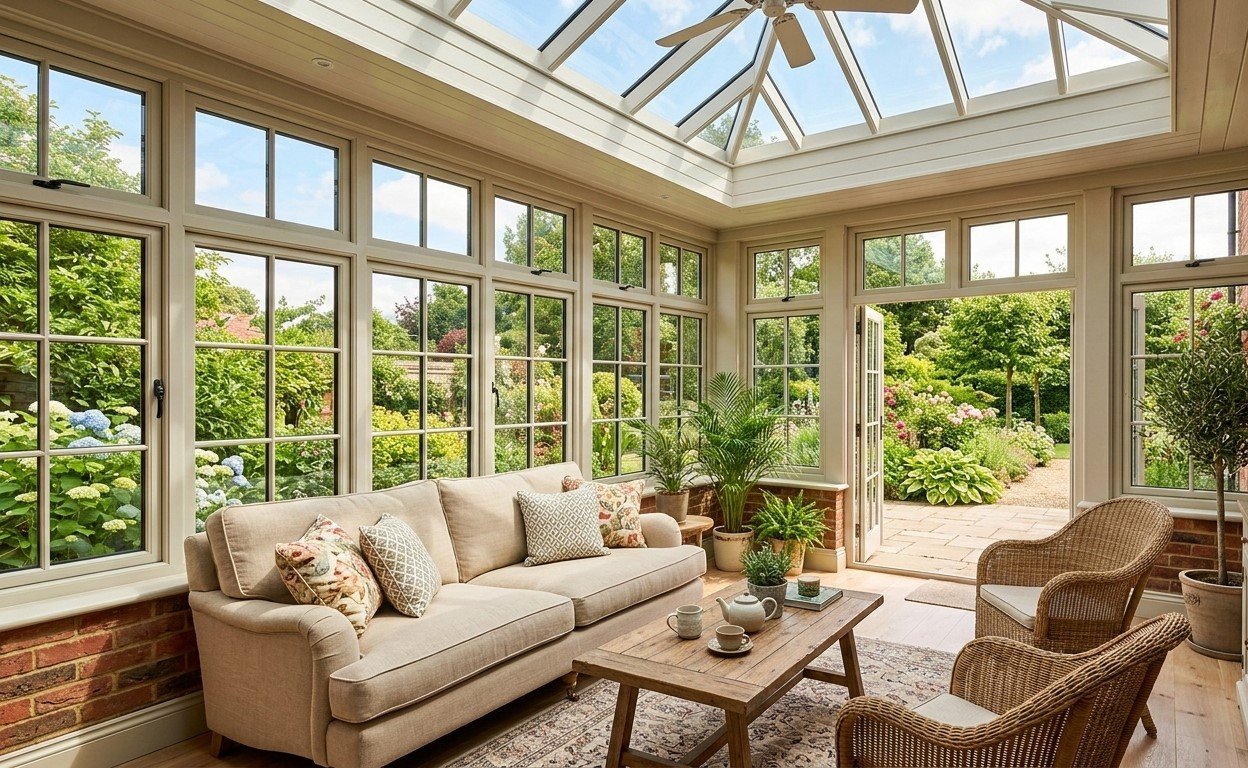
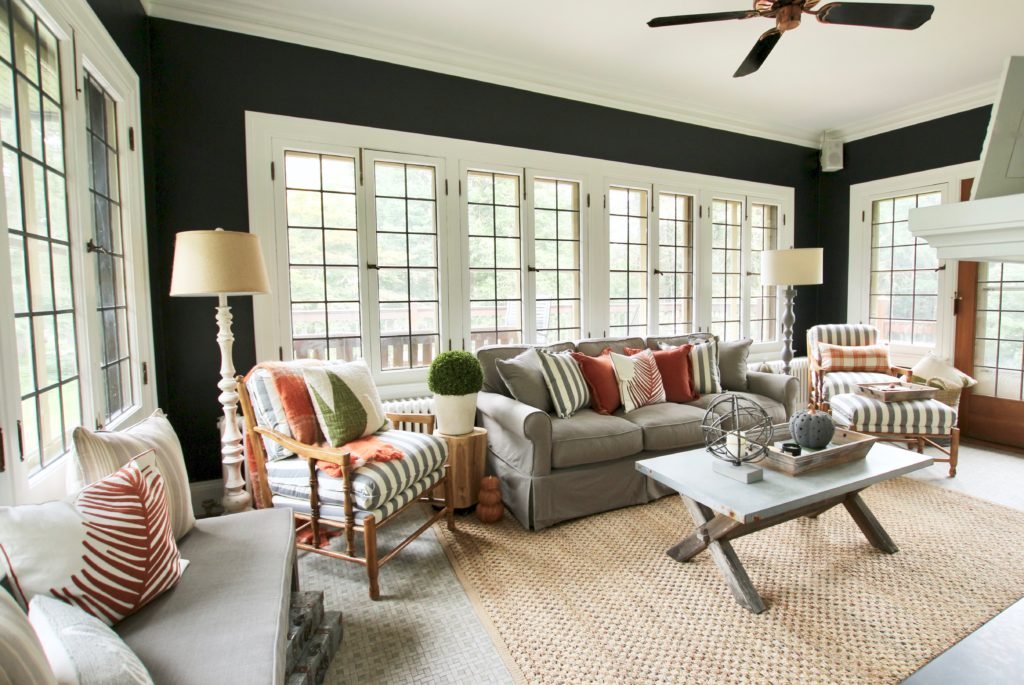
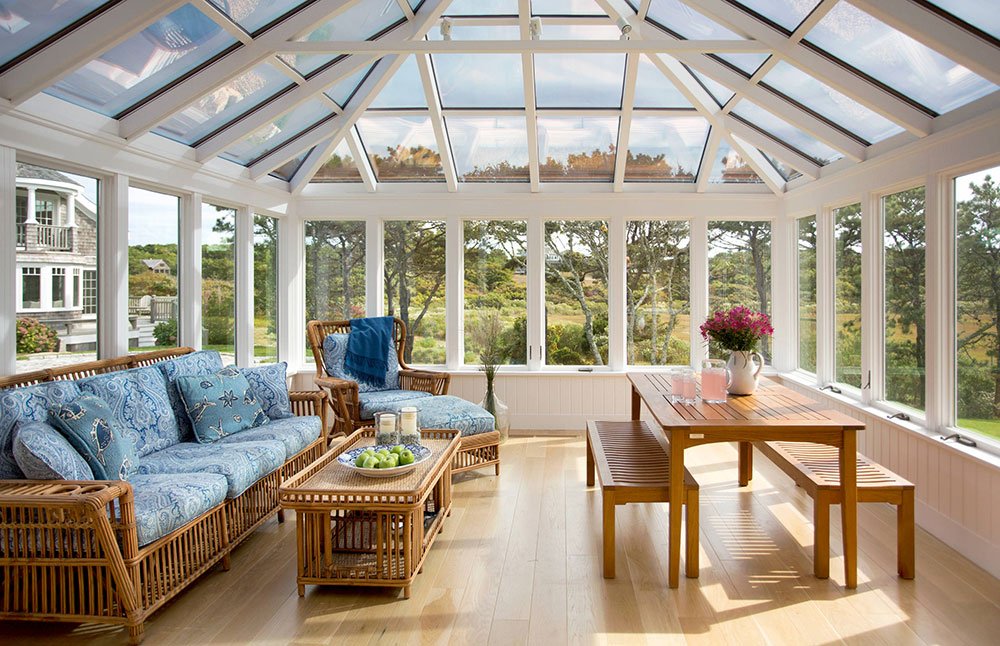
A sunroom is a glass-enclosed living space designed to maximize natural light while managing seasonal temperature changes. Depending on insulation, windows, and HVAC integration, it can function as a 3-season room or a fully climate-controlled 4-season extension of your home.
What is a sunroom and how is it different from a regular room?
A sunroom is defined by glass dominance.
Unlike a standard room with insulated walls and limited windows, a sunroom contains large expanses of glazing. This creates unique performance challenges:
- Higher solar heat gain
- Greater heat loss potential
- Increased condensation risk
- More exposure to UV radiation
A sunroom is not simply an extension. It is an environmental system.
What Is a Sunroom in Simple Terms?
A sunroom is a glass-enclosed living space designed to maximize natural light while controlling temperature through insulation, glazing performance, and ventilation. It can be built as a 3-season room for mild weather or a fully insulated 4-season extension usable year-round.
What Determines Whether a Sunroom Is Comfortable?
Comfort depends on climate alignment. Glass U-factor controls winter heat loss, SHGC controls summer heat gain, insulation stabilizes temperature swings, and ventilation prevents condensation. Orientation and regional weather patterns are the most important design inputs.
Is a Sunroom Worth the Investment?
A properly engineered 4-season sunroom can increase usable space, improve property appeal, and reduce seasonal heating load when aligned with climate and orientation. Poorly specified sunrooms often suffer from overheating, condensation, and higher energy costs.
How Do You Choose the Right Sunroom Type?
(5-Step Decision Path)
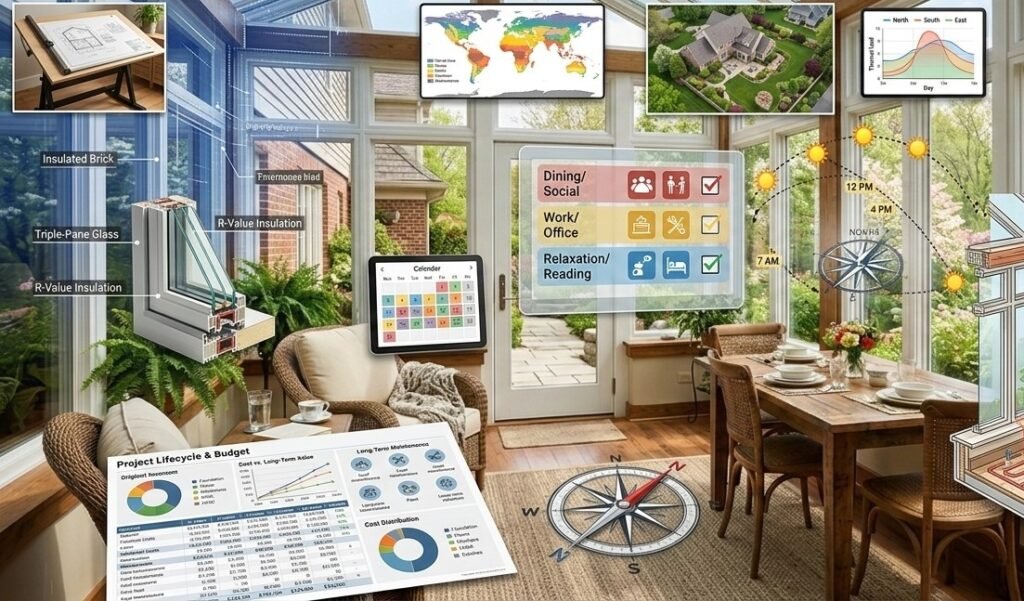
If you follow these five steps in order, you eliminate 80 percent of common mistakes.
Step 1 — Define Climate Zone
Cold = prioritize U-factor
Hot = prioritize SHGC
Humid = prioritize ventilation + mold resistance
Mixed = balance both metrics
Climate defines glass. Not aesthetics.
Step 2 — Determine Usage Pattern
Occasional seasonal use → 3-season
Daily year-round living space → 4-season
Architectural feature + aesthetic focus → Conservatory
Usage defines insulation level.
Step 3 — Analyze Orientation
South-facing → passive solar opportunity
West-facing → overheating risk
North-facing → heat loss focus
Orientation modifies glazing selection.
Step 4 — Decide HVAC Strategy
No HVAC → seasonal limitations
Mini-split → flexible and efficient
Extend central HVAC → integrated but load-sensitive
HVAC decision determines usability.
Step 5 — Align Budget With Lifecycle
Lower upfront cost = higher long-term operating cost
Higher glazing spec = longer comfort stability
Think 15 years, not 2.
What are the different types of sunrooms?
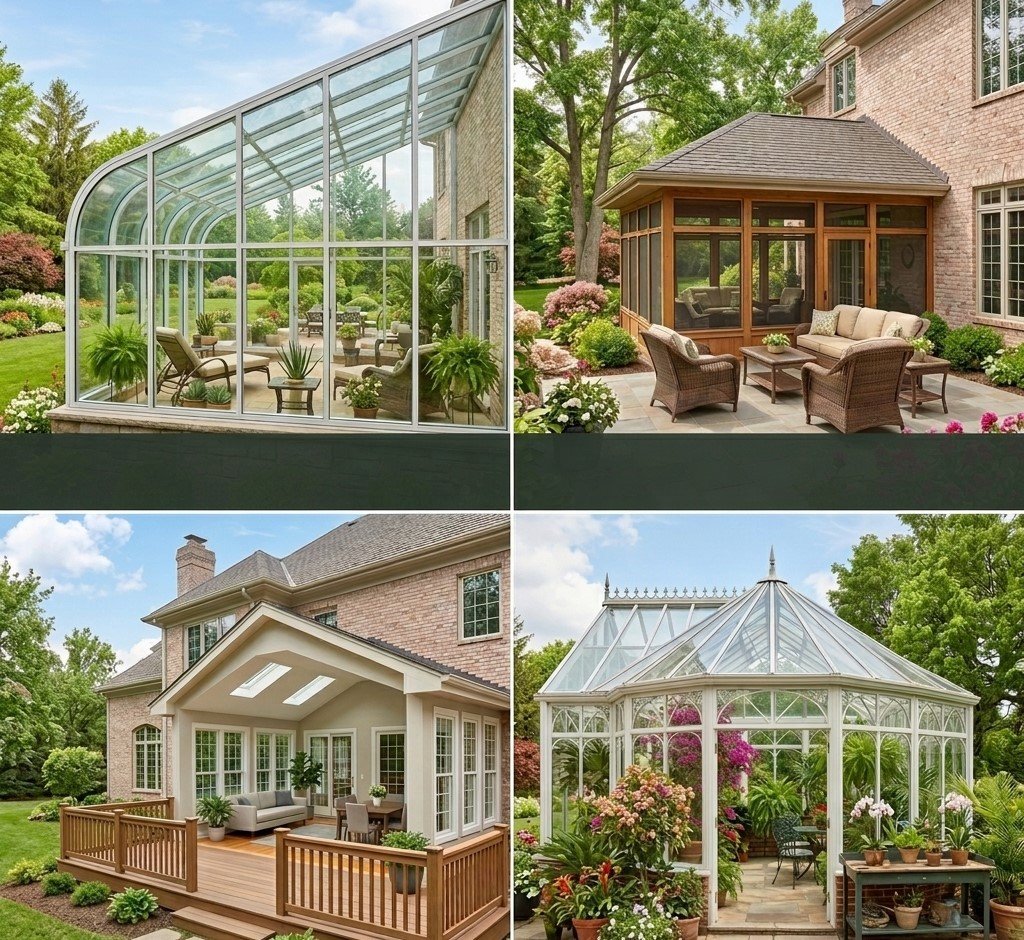
Sunrooms are classified by insulation level and seasonal usability.
3-Season Sunroom
Designed for spring, summer, and fall use. Typically features lighter insulation and basic glazing. Not intended for freezing climates.
4-Season Sunroom
Built with insulated glass, energy-efficient frames, and often integrated with home HVAC. Usable year-round.
Conservatory
Architecturally ornate sunroom with full glass walls and often glass roofing.
Enclosed Patio / Florida Room
Usually a converted patio space with screened or glass enclosure.
Each type has different material and energy requirements.
How do sunroom windows impact comfort and energy performance?
Sunroom windows control heat transfer more than any other element.
Key metrics:
- U-factor (heat loss rate)
- SHGC (solar heat gain)
- Visible transmittance
- Gas fill and spacer systems
In cold climates, low U-factor reduces winter heat loss.
In hot climates, low SHGC prevents overheating.
Glass selection defines comfort. For detailed U-factor and SHGC recommendations by climate zone, see the full Sunroom Windows guide.
How does insulation affect sunroom usability?
Insulation determines whether a sunroom is seasonal or year-round.
Critical insulation areas:
- Floor system
- Roof panels
- Wall framing
- Window seals
Without proper insulation, temperature swings become extreme.
4-season sunrooms require envelope performance close to main house standards.
How should heating and cooling be handled in a sunroom?
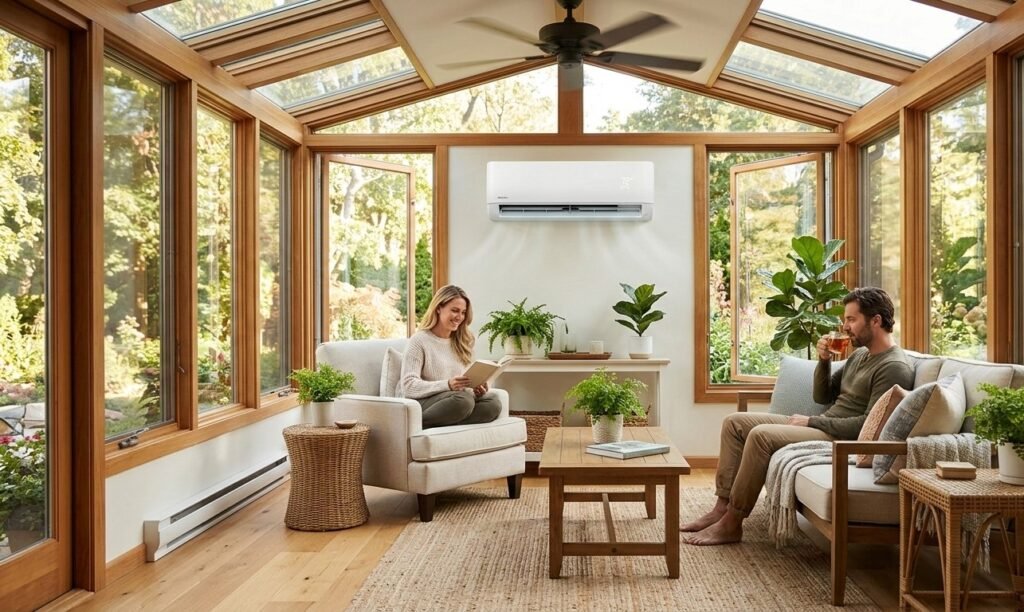
Sunrooms amplify both heat gain and heat loss.
Heating options:
- Extending central HVAC
- Mini-split systems
- Electric baseboard
- Radiant floor heating
Cooling strategies:
- Ventilation
- Ceiling fans
- Mini-splits
- Exterior shading
HVAC load calculations must account for glazing ratio.
What flooring works best in a sunroom?
Flooring must tolerate UV exposure and temperature shifts.
Best options:
- Porcelain tile
- Luxury vinyl plank (UV-resistant grade)
- Engineered hardwood
- Sealed concrete
Natural hardwood may expand and contract excessively under high sunlight.
What furniture works in a sunroom?
Furniture must tolerate high light and moderate humidity variation.
Key considerations:
- UV-resistant fabrics
- Mold-resistant cushions
- Stable frame materials
- Fade-resistant upholstery
Indoor furniture may deteriorate quickly without protective glazing.
For performance-level detail, see:
→ Sunroom Furniture Guide (internal link)
How does climate affect sunroom design?
Climate dictates specifications.
Cold climates require:
- Insulated glazing
- Lower U-factor
- Strong condensation control
Hot climates require:
- Solar control glass
- Lower SHGC
- Strong ventilation
Humid climates require:
- Mold-resistant materials
- Airflow design
- Moisture-tolerant furnishings
Climate mismatch causes most sunroom dissatisfaction.
What orientation is best for a sunroom?
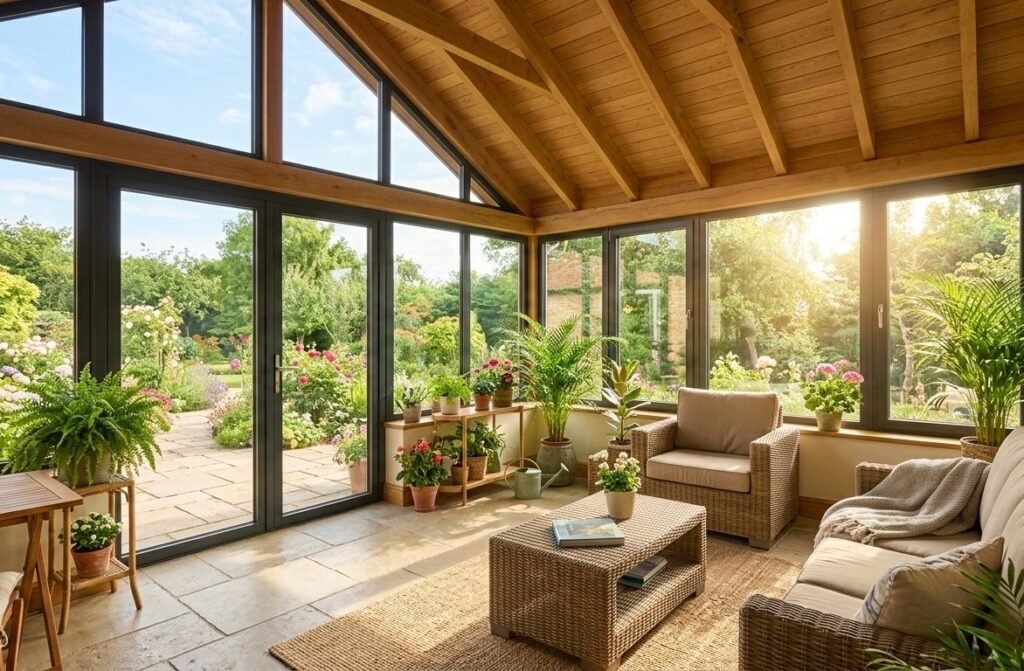
Orientation determines solar load.
South-facing:
- Strong winter gain
- Summer overheating risk
West-facing:
- Afternoon heat spike
North-facing:
- Lower solar gain
- Higher heat loss risk
Orientation should influence glazing selection more than style preferences.
What are the most common sunroom problems?
- Overheating in summer
- Condensation in winter
- UV fading of furnishings
- Seal failure in windows
- HVAC imbalance
Most problems result from mismatched specifications.
How much does it cost to build a sunroom?
Costs vary widely by type.
3-season sunroom:
$8,000–$20,000+
4-season insulated sunroom:
$20,000–$50,000+
Custom conservatories can exceed these ranges significantly.
Major cost drivers:
- Glass performance level
- Structural integration
- HVAC expansion
- Permits
Are sunrooms worth the investment?
Value depends on build quality.
A properly insulated 4-season sunroom:
- Increases usable square footage
- Improves property appeal
- Enhances natural light
- Provides year-round relaxation space
A poorly specified sunroom becomes underused space. Performance alignment determines ROI.
Sunroom System Summary
A successful sunroom balances:
- Glass performance
- Insulation
- Ventilation
- Climate control
- Material durability
It is not a decor project. It is a thermal and environmental design project.
Sunroom in 10 Practical Rules
- Match glazing to climate
- Consider orientation before design
- Plan ventilation intentionally
- Insulate floors and roof properly
- Budget for HVAC integration in 4-season rooms
- Choose UV-resistant furnishings
- Expect seal lifespan of 15–20 years
- Verify building code requirements
- Design for condensation control
- Think lifecycle, not just upfront cost
Sunroom as an Environmental System (Advanced Concept Layer)
A sunroom is not a room with extra windows.
It is a hybrid environmental chamber where:
- Solar radiation enters freely
- Heat escapes more easily than in standard walls
- Humidity levels fluctuate
- Surface temperatures change faster
- UV exposure increases material stress
Think of it as a semi-controlled greenhouse attached to a house.
The difference between a comfortable sunroom and an unusable one is whether the design acknowledges this.
Thermal Physics of a Sunroom
Understanding sunroom performance requires basic heat transfer awareness.
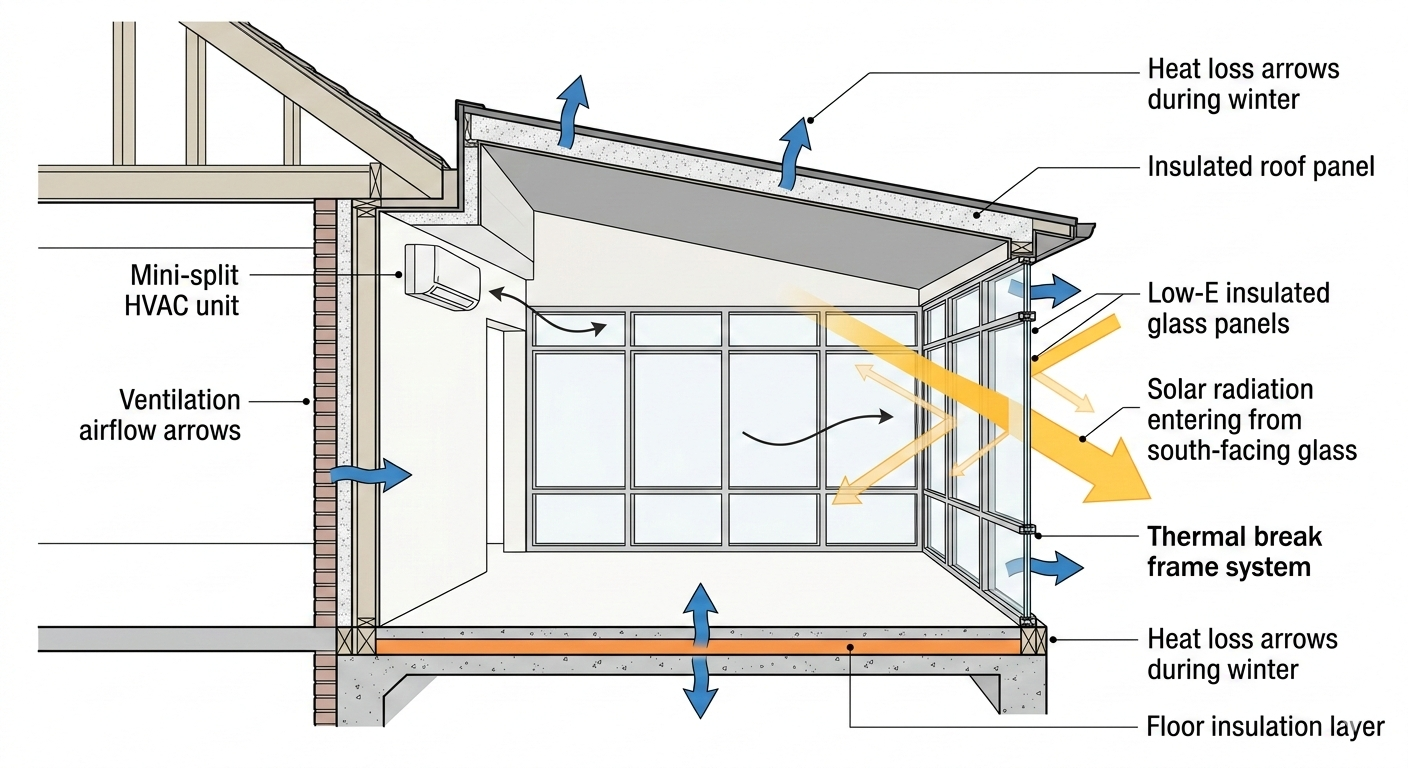
There are three forms of heat transfer:
- Conduction — heat passing through glass and frames
- Radiation — solar energy entering through glazing
- Convection — air movement within the room
Because glass conducts heat more than insulated walls, conduction losses are higher in winter.
Because glass allows radiation, solar gain is amplified in summer. This duality makes sunrooms highly climate-sensitive.
Detailed Climate Modeling by Region
Cold Northern Climates (Canada, Northern Europe, Northern US)
Winter temperatures can drop well below freezing.
Key design focus:
- Low U-factor glazing
- Triple-pane in extreme regions
- Insulated frames
- Floor insulation
- Thermal breaks in aluminum
Condensation becomes the primary risk.
Interior humidity must be controlled. Without proper insulation, frost may form at glass edges.
A properly designed cold-climate sunroom can capture passive solar heat on sunny winter days, reducing heating load.
But if glazing is mismatched, heating bills increase significantly.
Hot Desert Climates (Arizona, Middle East, Australia)
Sunrooms here risk becoming solar ovens.
Design focus:
- Very low SHGC
- Solar control Low-E coatings
- Exterior shading structures
- Ventilation planning
West-facing glass must be minimized or heavily shaded.
In extreme heat, mechanical cooling may be mandatory even for short-term use.
Thermal comfort becomes the priority over insulation.
Humid Coastal Regions (Florida, Southeast Asia)
Humidity fluctuates heavily.
Design focus:
- Mold-resistant materials
- Corrosion-resistant hardware
- Balanced ventilation
- Condensation control
Salt air accelerates corrosion in metal frames.
Furniture and flooring choices must account for long-term humidity exposure. Moisture accumulation behind walls or under flooring can cause hidden damage.
Mixed Climate Regions (UK, Midwest US, Central Europe)
These climates require balanced specifications.
Design focus:
- Moderate SHGC
- Strong insulation
- Operable ventilation
- Seasonal flexibility
Over-insulating without allowing solar gain can reduce winter comfort.
Under-specifying glass increases seasonal swings.
Balanced engineering wins here.
Roof System Engineering in Sunrooms
The roof is often overlooked.
But it is the highest heat exposure surface.
Roofing Options
- Insulated solid roof panels
- Glass roof panels
- Polycarbonate roofing
- Hybrid insulated + glass sections
Glass roofing dramatically increases solar load.
Solid insulated roofing improves thermal stability.
In hot climates, solid roofing is usually preferable.
In cold climates, partial glazing may help passive gain.
Roof design heavily influences comfort.
Structural Load & Expansion Considerations
Glass expands and contracts with temperature.
Metal frames expand faster than vinyl.
Seasonal movement can loosen fasteners or create micro-gaps.
Large glass panels require structural reinforcement to prevent flexing.
Wind load and snow load must be calculated properly.
Improper structural modeling leads to seal failure over time.
Advanced Window Performance Engineering
Most people stop at “double-pane.”
Real performance differences lie in:
- Spacer material conductivity
- Sealant durability
- Glass thickness variation
- Gas retention lifespan
Warm-edge spacers reduce condensation at perimeter edges.
Krypton gas performs better than argon but costs more.
Soft-coat Low-E is better for solar control than hard-coat in most cases. Details matter. For more informmation, refer to our advanced sunroom windows page for expert analysis regarding windows engineering and preformance.
Sunroom HVAC Load Calculation Principles
HVAC sizing must account for:
- Glass ratio
- Solar orientation
- Insulation R-values
- Room volume
- Air infiltration rate
Oversized units short-cycle and reduce efficiency.
Undersized units cannot stabilize temperature.
Mini-split systems often perform best because they allow independent control.
Sunrooms should rarely rely on passive airflow alone in extreme climates.
Furniture & Interior Material Stress Modeling
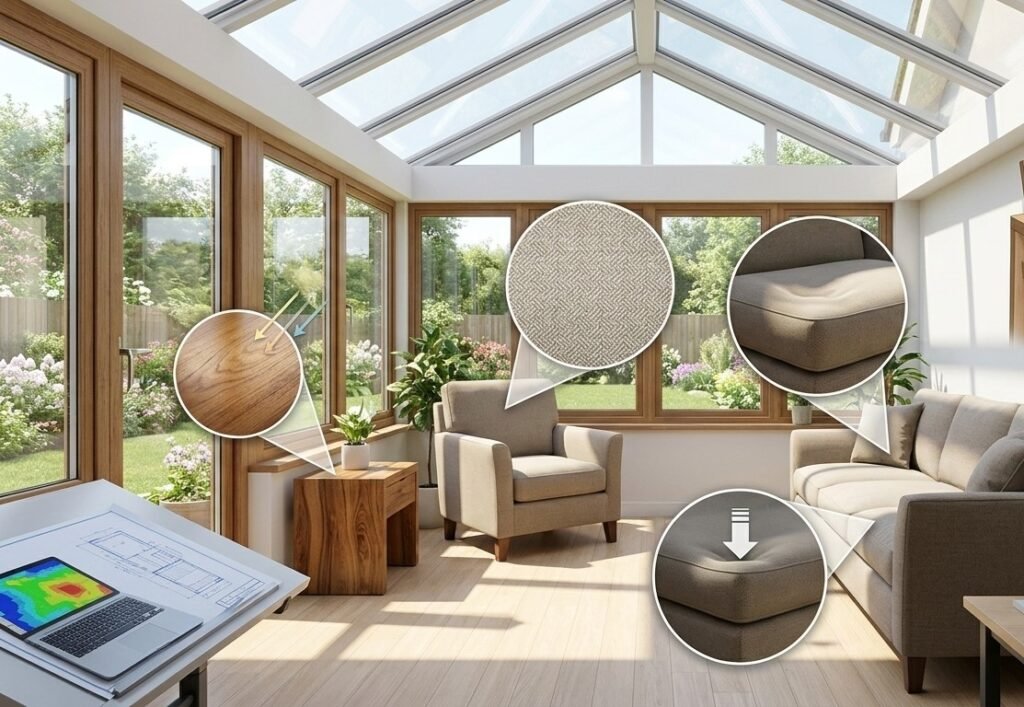
High UV exposure degrades:
- Fabric fibers
- Cushion foam
- Wood finishes
- Adhesives
UV passes through most untreated glass.
Even Low-E glazing does not eliminate all UV radiation.
Cushions may fade within 2–5 years without protective fabric.
Resin wicker may become brittle in cold climates below freezing.
Teak tolerates humidity but may silver over time.
Indoor-only furniture in a 4-season sunroom may deteriorate rapidly.
Material science matters.
Flooring Thermal Behavior
Flooring expands and contracts.
Tile tolerates sunlight well.
Engineered hardwood performs better than solid hardwood.
Luxury vinyl plank must be rated for UV exposure.
Concrete performs best structurally but may feel cold in winter.
Floor insulation underneath is often underestimated. Cold floors reduce comfort significantly even when air temperature is stable.
Condensation Case Analysis
Condensation forms when glass surface temperature drops below dew point.
In winter:
Warm air inside meets cold glass.
Without:
- Low U-factor glazing
- Adequate ventilation
- Humidity control
Condensation becomes frequent.
Over time, this damages:
- Window seals
- Adjacent framing
- Flooring
- Furniture bases
Condensation is not cosmetic. It is structural risk.
20-Year Lifecycle Modeling
Year 0–5:
Minimal issues if properly specified.
Year 5–10:
Seal degradation may begin.
Year 10–15:
Cushion replacement likely.
Minor hardware replacements.
Year 15–20:
Glass seal failure possible.
Insulated unit replacement required.
Sunrooms require long-term maintenance planning.
Lifecycle thinking separates durable builds from short-term ones.
Real-World Scenario: Under-Specified Sunroom
Location: Midwest US
Type: 4-season sunroom
Glass: Basic double-pane
Orientation: West-facing
Result:
Overheating in summer.
HVAC strain.
Condensation in winter.
Root cause:
SHGC too high.
Ventilation inadequate. Lesson:
Glass must match orientation.
Real-World Scenario: Over-Specified Sunroom
Location: Northern UK
Type: 3-season room
Glass: Triple-pane ultra-low SHGC
Orientation: South-facing
Result:
Winter feels colder than expected.
Solar gain blocked excessively.
Lesson:
Overengineering can reduce passive heating benefits. Balance beats extremes.
Energy Cost Modeling Over 15 Years
Assume:
Basic glazing energy increase: $600/year
High-performance glazing increase: $300/year
15-year savings difference:
$4,500
Subtract $2,500 glazing upgrade:
Net savings: $2,000
Comfort benefit not included.
Performance alignment compounds financially.
Building Code & Resale Impact
Poorly permitted sunrooms:
- May not count as official square footage
- May reduce resale value
- May complicate insurance
4-season sunrooms meeting energy code often increase perceived value significantly.
Compliance matters.
Most Expensive Sunroom Mistakes
- Ignoring climate
- Ignoring orientation
- Using indoor furniture in high UV
- Skipping insulation under flooring
- Failing to calculate HVAC load
- Choosing cheapest glazing
Every mistake connects to underestimating environmental exposure.
Sunroom Design Is System Design
Sunroom success depends on:
- Climate-aware glazing
- Structural reinforcement
- Ventilation engineering
- Moisture control
- Material durability
- Lifecycle planning
It is a system of interdependent parts.
Remove one element and performance drops.
Final System-Level Summary
A sunroom is:
- A high-glass environmental extension
- A solar energy amplifier
- A condensation risk zone
- A UV exposure chamber
- A thermal fluctuation space
Comfort comes from alignment. Misalignment causes dissatisfaction.
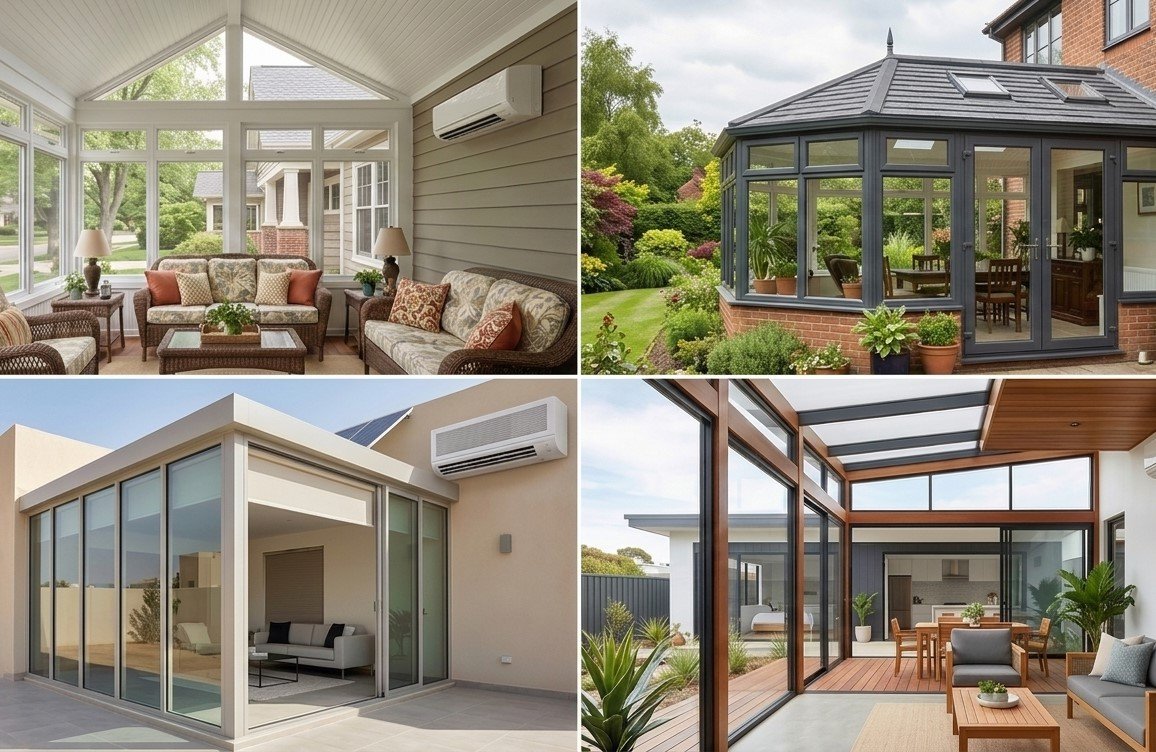
Regional Sunroom Design Examples (US, UK, Middle East, Australia)
How Sunroom Design Changes by Region
Sunroom design is not universal. Regional climate patterns, building codes, cultural usage habits, and energy costs influence specifications.
Below are four regional breakdowns.
🇺🇸 United States — Mixed & Climate-Diverse Modeling
The US contains multiple climate zones, so sunroom design varies significantly.
Northern States (Minnesota, New York, Michigan)
Primary concern: Winter heat retention
Design traits:
- Double or triple-pane Low-E glass
- Vinyl or fiberglass frames
- Insulated solid roof systems
- HVAC extension or mini-split
South-facing designs can reduce heating costs in winter through passive solar gain.
West-facing sunrooms often require shading due to summer overheating.
Energy costs vary widely by state, making glazing selection financially important.
Southern States (Texas, Florida, Arizona)
Primary concern: Solar heat gain
Design traits:
- Low SHGC glass
- Solar control coatings
- Exterior shading structures
- Strong ventilation planning
- Mold-resistant furnishings
In Florida, humidity is as important as heat.
In Arizona, SHGC matters more than U-factor.
🇬🇧 United Kingdom — Conservatory Culture & Condensation Risk
The UK has a long conservatory tradition.
Primary challenges:
- Damp winters
- Moderate summers
- High humidity
- Frequent condensation
Design traits:
- Balanced SHGC glazing
- Strong condensation management
- Warm-edge spacers
- Insulated roof retrofits (common upgrade trend)
Many older UK conservatories suffer from:
- Overheating in summer
- Freezing conditions in winter
Modern retrofits often replace polycarbonate roofs with insulated panels.
Energy efficiency regulations are stricter now than in early 2000s builds.
🇦🇪 Middle East — Extreme Solar Exposure
In desert climates (UAE, Saudi Arabia):
Primary challenge:
Extreme solar radiation and high ambient temperatures.
Design traits:
- Very low SHGC (≤0.25)
- Reflective or tinted glass
- Exterior shading mandatory
- Minimal west-facing glazing
- Mechanical cooling required
Glass roofing is rarely practical unless heavily shaded.
Interior finishes must resist UV degradation.
Over-insulating without controlling solar gain creates thermal traps.
🇦🇺 Australia — UV Intensity & Bushfire Considerations
Australia presents two main issues:
- High UV intensity
- Bushfire compliance in certain regions
Design traits:
- UV-stabilized glazing
- Laminated safety glass in bushfire zones
- Strong ventilation planning
- Durable flooring materials
North-facing sunrooms (in Southern Hemisphere) receive maximum winter sunlight.
Orientation logic flips compared to Northern Hemisphere.
This affects SHGC strategy.
Regional Comparison Snapshot
| Region | Primary Risk | Glass Priority | Structural Focus |
| Northern US | Heat loss | Low U-factor | Insulation |
| Southern US | Overheating | Low SHGC | Ventilation |
| UK | Condensation | Balanced | Moisture control |
| Middle East | Extreme solar | Ultra-low SHGC | Shading |
| Australia | UV & fire | UV-stable glass | Safety compliance |
Why Regional Modeling Matters
Many guides ignore geography.
But a sunroom that performs well in Minnesota will fail in Dubai.
Regional design awareness:
- Prevents overheating
- Reduces condensation
- Improves energy efficiency
- Extends material lifespan
This is where authority content separates from generic content.
Climate Simulation Breakdowns: What Actually Happens in a Sunroom
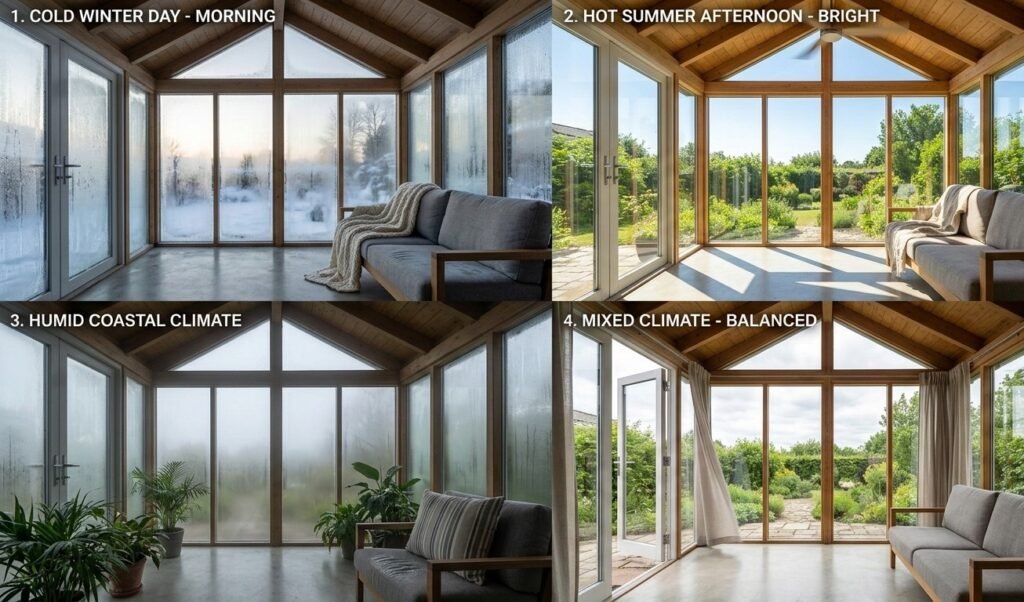
Most guides say “sunrooms get hot” or “sunrooms lose heat.” That’s true, but vague. A better approach is to simulate how a sunroom behaves across a typical day and season, because comfort problems almost always show up in predictable patterns.
These simulations are not lab-perfect models. They’re design-grade mental models that explain where failures happen and what specs prevent them.
Simulation 1: Cold Winter Day (4-season sunroom, outside -5°C / 23°F)
Morning (7–10 AM)
- Outdoor air is cold.
- Glass surfaces are coldest because they’ve been losing heat overnight.
- Interior humidity meets cold glass and condensation forms if glazing is weak.
Failure signal: water droplets at glass edges and along frames.
Design fix logic:
- Lower U-factor reduces glass surface cooling.
- Warm-edge spacers prevent edge condensation.
- Better seals reduce cold drafts that trigger dew point drop.
Midday (11 AM–2 PM)
- Sun begins heating interior through solar radiation.
- South-facing sunrooms can gain noticeable warmth even in cold air.
Success signal: interior temperature rises naturally without heavy HVAC cycling.
Design fix logic:
- Moderate SHGC is beneficial in cold climates.
- Overly low SHGC can block useful winter solar gain, making the room feel dead and cold.
Evening (5–10 PM)
- Solar gain disappears.
- Glass begins shedding heat rapidly.
Failure signal: temperature drops faster than the rest of the home.
Design fix logic:
- Insulated roof and floor reduce rapid heat loss.
- HVAC integration matters more than window type at this stage.
Simulation 2: Hot Summer Afternoon (outside 40°C / 104°F, strong sun)
Morning (8–11 AM)
- Sun starts loading the glass.
- Interior warms quickly due to radiant gain.
Hidden insight: interior blinds reduce glare but don’t stop heat gain effectively because heat already passed through the glazing.
Design fix logic:
- Low SHGC solar control glass reduces heat entering in the first place.
- Exterior shading is more effective than interior shading.
Midday (12–4 PM)
- Peak solar load.
- West-facing rooms experience the worst spike in late afternoon.
Failure signal: interior feels like a greenhouse and AC can’t keep up.
Design fix logic:
- Low SHGC is the main control variable.
- Cross ventilation and stack ventilation reduce trapped heat.
- Solid insulated roof performs better than glass roof here.
Evening (6–10 PM)
- Exterior temperature drops slowly in hot regions.
- Stored heat in surfaces releases back into the room.
Failure signal: room stays hot long after sunset.
Design fix logic:
- Thermal mass management (tile, concrete) can help if paired with night ventilation.
- Poor ventilation traps heat overnight.
Simulation 3: Humid Coastal Climate (high humidity, mild temperature swings)
Primary issue is not temperature. It’s moisture behavior.
Morning
- Cool glass meets humid air.
- Condensation can form even when it’s not “cold.”
Failure signal: damp cushions, foggy windows, musty smell.
Design fix logic:
- Ventilation becomes non-negotiable.
- Mold-resistant materials matter more than high insulation.
- Moisture-tolerant flooring prevents hidden damage.
Midday
- Sun dries surfaces but humidity stays high.
Hidden risk: furniture and cushions trap moisture internally.
Design fix logic:
- Quick-dry foam and breathable fabrics.
- Air circulation prevents moisture stagnation.
Simulation 4: Mixed Climate (cold winters, hot summers)
Mixed climates punish “one-trick” designs.
Winter need: low U-factor
Summer need: low SHGC
This creates a real design tension.
Balanced approach:
- Double-pane Low-E
- Moderate SHGC (not extreme)
- Shading options that can be adjusted seasonally
- Operable windows for spring/fall
Failure signal: room is uncomfortable in both seasons because specs are wrong for the region’s extremes.
24-Hour Heat Cycle Snapshot (Simple Model)
A sunroom generally follows this pattern:
- Overnight heat loss through glass
- Morning surface warming
- Midday solar heat gain peak
- Late afternoon overheating risk (west exposure)
- Evening rapid cool-down (cold climates) or slow cool-down (hot climates)
If you design for these five phases, you design a comfortable sunroom.
Practical “Simulation Outcomes” Checklist
If your sunroom does any of these, it indicates a spec mismatch:
- Condensation appears daily in winter
- AC runs constantly in summer afternoons
- Room becomes unusable during peak sun hours
- Furniture fades unusually fast
- Musty smell develops after humid weather
Each symptom points directly to a design variable you can fix.
Detailed Material Comparison: Sunroom System Components
A sunroom is only as strong as its weakest material choice.
The tables below compare performance trade-offs across glazing, frames, roofing, flooring, and furniture materials.
Glass Package Comparison
Performance-Oriented Glazing Matrix
| Glass Type | U-Factor (Typical) | SHGC (Typical) | Best Climate | Overheating Risk | Winter Heat Loss | Cost Tier |
| Single Pane | 0.9–1.2 | 0.70–0.85 | Mild only | Very High | Very High | Low |
| Double Pane (clear) | 0.45–0.60 | 0.60–0.70 | Moderate | High | Moderate | Moderate |
| Double Pane Low-E | 0.28–0.35 | 0.30–0.45 | Mixed | Moderate | Low | Moderate–High |
| Triple Pane Low-E | 0.18–0.28 | 0.25–0.40 | Cold | Low | Very Low | High |
| Solar Control Glass | 0.30–0.40 | 0.20–0.30 | Hot | Very Low | Moderate | High |
Interpretation
- Cold climates prioritize U-factor.
- Hot climates prioritize SHGC.
- Mixed climates need balance.
- Over-specifying SHGC can reduce winter comfort.
There are vaste metrics regarding the types of Sunroom Windows that depend on the location, size, budgeting, ones’s own flavor of choice and elegancy, all explained with real world scenarios in our Sunroom Windows Deep Breakdown.
Frame Material Comparison
| Frame Type | Thermal Conductivity | Condensation Risk | Expansion Stability | Maintenance | Best Climate |
| Vinyl | Low | Low | Moderate | Low | Cold / Mixed |
| Aluminum (no break) | High | High | High | Low | Warm |
| Aluminum (thermal break) | Moderate | Moderate | High | Low | Mixed / Hot |
| Fiberglass | Low | Low | Very Stable | Low | All climates |
| Wood | Low | Moderate (humidity) | Moderate | High | Mild / Aesthetic focus |
Hidden Insight
Aluminum without thermal break is a condensation magnet in cold climates.
Fiberglass is structurally superior but more expensive.
Roof System Comparison
| Roof Type | Insulation Value | Solar Gain | Noise Reduction | Climate Fit | Cost |
| Solid Insulated Panels | High | Low | High | Cold / Mixed | Moderate |
| Full Glass Roof | Low–Moderate | Very High | Moderate | Mild | High |
| Polycarbonate Panels | Moderate | High | Low | Moderate | Lower |
| Hybrid Roof (glass + solid) | Balanced | Balanced | Balanced | Mixed | High |
Interpretation
Glass roofing increases daylight but magnifies overheating risk.
Solid insulated roofing improves temperature stability significantly.
Hybrid roofs offer seasonal flexibility.
Flooring Material Comparison
| Flooring Type | UV Resistance | Expansion Tolerance | Moisture Resistance | Comfort | Best Climate |
| Porcelain Tile | Excellent | Excellent | Excellent | Cool underfoot | Hot |
| Luxury Vinyl Plank (UV-rated) | Good | Good | Good | Moderate | Mixed |
| Engineered Hardwood | Moderate | Moderate | Moderate | Warm | Cold |
| Solid Hardwood | Low | Low | Low | Warm | Mild |
| Sealed Concrete | Excellent | Excellent | Excellent | Cool | All climates |
Interpretation
Solid hardwood performs poorly under high UV and temperature swings.
Engineered hardwood is safer but still climate-dependent.
Furniture Material Comparison
Frame Materials
| Material | UV Resistance | Humidity Tolerance | Cold Tolerance | Lifespan (Avg) | Climate Fit |
| Natural Wicker | Low | Moderate | Poor (cracks) | 5–8 yrs | Mild |
| Resin Wicker | High | High | Moderate | 8–12 yrs | Mixed |
| Teak | High | High | Good | 15+ yrs | All |
| Powder-Coated Aluminum | High | High | Excellent | 15+ yrs | All |
| Upholstered Wood | Low | Low | Moderate | 5–10 yrs | Controlled |
Cushion & Fabric
| Fabric Type | Fade Resistance | Mold Resistance | Maintenance | Lifespan |
| Standard Cotton Blend | Low | Low | Moderate | 2–4 yrs |
| Polyester Outdoor Blend | Moderate | Moderate | Low | 4–6 yrs |
| Performance Fabric (Sunbrella-type) | High | High | Low | 6–10 yrs |
| Quick-Dry Foam | N/A | High | Low | Long |
Interpretation
Indoor furniture rarely survives long-term in high-light sunrooms.
Performance fabrics justify higher cost in 4-season rooms.
HVAC Strategy Comparison
| System | Installation Complexity | Energy Efficiency | Cost | Best For |
| Extend Central HVAC | Moderate | Moderate | Medium | 4-season |
| Mini-Split System | Moderate | High | Medium–High | All climates |
| Electric Baseboard | Low | Low | Low | Mild climates |
| Radiant Floor | High | High | High | Cold climates |
Mini-splits often provide the most controlled performance.
Material Decision Logic Summary
If climate is cold:
- Prioritize insulation
- Vinyl or fiberglass frames
- Double or triple pane
- Insulated roof
If climate is hot:
- Prioritize low SHGC
- Solar control glass
- Exterior shading
- Ventilation-first approach
If climate is humid:
- Mold-resistant materials
- Corrosion-resistant frames
- Ventilation planning
This is system thinking, not component thinking.
Real Project Example: Cold vs Hot Climate Contrast
Case A — Minneapolis, US (Cold Climate)
Client built a 240 sq ft south-facing 4-season sunroom.
Initial quote included standard double-pane glass (U-factor 0.50).
After modeling, they upgraded to Low-E double-pane (U-factor 0.28).
Results over first 2 winters:
- Interior temperature more stable
- Condensation nearly eliminated
- Heating bill impact lower than expected
Upgrade cost difference: ~$2,700
Estimated 15-year energy impact: positive ROI
Comfort outcome: year-round usable reading space.
Case B — Dubai, UAE (Extreme Solar)
Client built 200 sq ft glass-heavy sunroom with standard glazing.
Problem:
Afternoon temperature exceeded comfort range even with AC.
Solution retrofit:
- Added solar control film
- Installed exterior shading
- Improved ventilation
Lesson:
SHGC miscalculation created a thermal trap.
Cost of correction exceeded initial glazing upgrade cost.
The difference between these two projects was not budget.
It was climate alignment.
Advanced ROI Modeling: 15-Year Energy & Lifecycle Impact
Sunrooms influence energy use more than most homeowners expect. The financial outcome depends on:
- Climate zone
- Glazing specification
- Orientation
- Energy rates
- HVAC integration
Below are modeled examples using realistic global energy rate averages.
These are structured projections, not guaranteed savings.
Assumed Energy Rate Baseline (Global Averages)
| Region | Electricity (per kWh) | Natural Gas (per therm equivalent) |
| United States | $0.16 | $1.20 |
| United Kingdom | £0.28 | £1.10 |
| Australia | AUD $0.30 | N/A (electric-heavy) |
| UAE | $0.08 | Minimal heating need |
Energy rates strongly influence ROI speed.
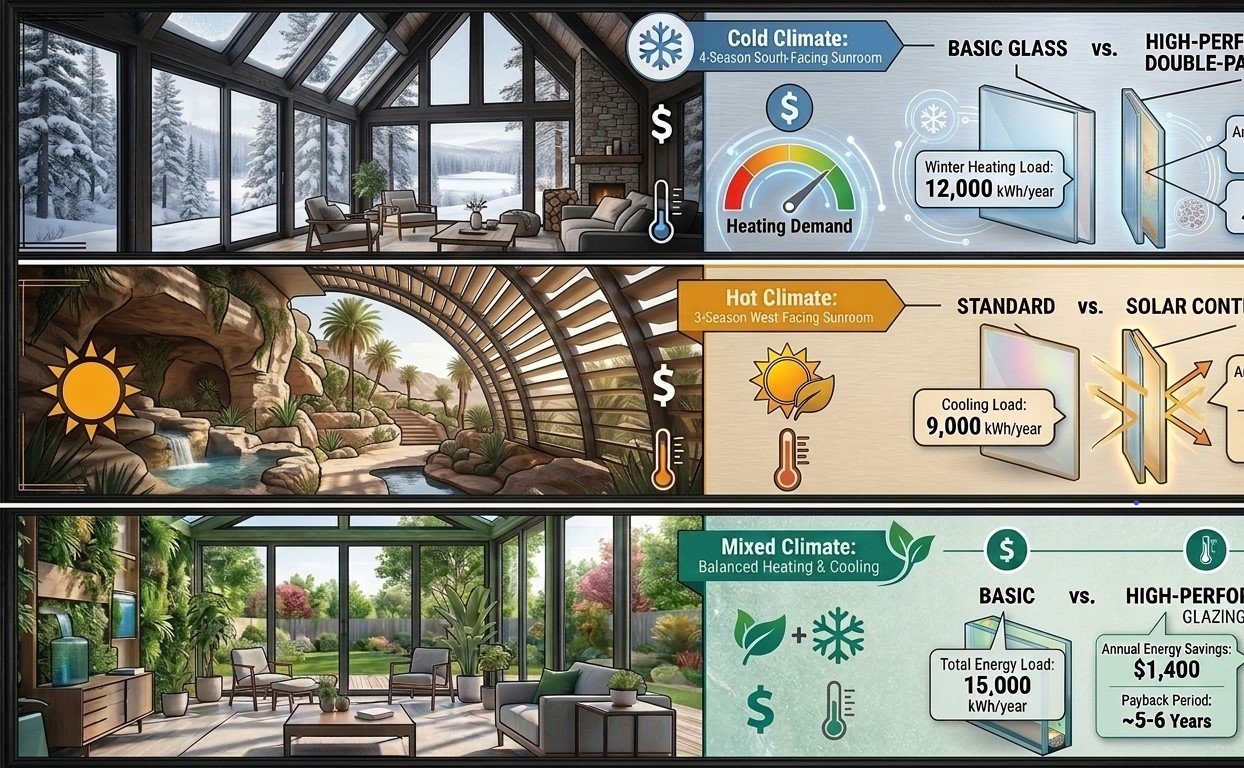
Scenario 1: Cold Climate ROI Model (Northern US / Canada Equivalent)
Sunroom size: 220 sq ft
Type: 4-season
Orientation: South-facing
Option A — Basic Double Pane (U-factor 0.50)
Estimated additional winter heating load:
~3,000–3,500 kWh per year equivalent
Annual heating cost impact:
~$480–$560
Option B — High-Performance Double Pane (U-factor 0.28)
Estimated heating load:
~1,800–2,200 kWh per year
Annual heating cost impact:
~$290–$350
Annual Savings Difference
~$200–$250 per year
Upgrade cost difference:
$2,500–$3,000
Simple payback:
10–12 years
15-Year Projection
Savings:
$3,000–$3,750
Net gain after upgrade:
~$750–$1,200
Comfort benefits excluded.
Scenario 2: Hot Climate ROI Model (Arizona / Middle East Equivalent)
Sunroom size: 220 sq ft
Type: 3-season
Orientation: West-facing
Option A — Standard Double Pane (SHGC 0.65)
Estimated additional cooling load:
~2,800–3,200 kWh annually
Cooling cost impact (US rate):
~$450–$510 annually
Option B — Solar Control Glass (SHGC 0.25)
Cooling load:
~1,600–1,900 kWh
Cooling cost:
~$250–$300 annually
Annual Savings Difference
~$200–$220 per year
Upgrade cost:
~$2,000 Payback:
~9–10 years
Middle East Variation
Electricity cost lower ($0.08/kWh).
Annual savings difference:
~$100–$120 per year
Payback period longer:
~15–18 years But overheating mitigation remains comfort-critical.
Scenario 3: Mixed Climate ROI (UK / Midwest US Equivalent)
Heating + Cooling balanced.
Basic glazing annual extra load:
~2,500 kWh equivalent
High-performance glazing:
~1,600 kWh
Savings:
~900 kWh annually
At UK rate (£0.28/kWh):
£252 annually
Upgrade cost:
£2,000–£3,000
Payback:
8–12 years
Higher electricity rates accelerate ROI.
Passive Solar Gain Value Modeling (Cold Climate Bonus)
South-facing 4-season sunroom can reduce heating load on adjacent rooms.
Estimated offset:
~500–800 kWh per year
At $0.16/kWh:
$80–$130 annual benefit
Over 15 years:
$1,200–$1,950 additional value
Proper orientation increases ROI significantly.
Lifecycle Cost Modeling (20-Year View)
| Component | Typical Replacement Cycle | Estimated Cost |
| Insulated Glass Units | 15–20 years | $2,000–$4,000 |
| Cushion Replacement | 5–8 years | $800–$1,500 |
| Seal Repairs | 10–15 years | $500–$1,000 |
Upfront investment in higher-quality materials often reduces long-term replacement frequency.
Cheap builds cost more over 20 years.
Comfort ROI (Non-Monetary but Influential)
Financial models ignore:
- Increased usable space
- Reduced HVAC strain
- Enhanced property appeal
- Lifestyle value
In resale markets, a properly permitted 4-season sunroom can increase perceived square footage value significantly.
In many US regions, finished space valuation ranges between $50–$150 per sq ft depending on build quality.
Net Present Value Perspective (Simplified)
If annual energy savings average $250
Over 15 years at modest inflation
Total savings: ~$4,000
Discounted value depends on rate assumptions, but real-world ROI is positive when:
- Energy rates are high
- Climate is extreme
- Glazing is optimized
ROI accelerates in high-electricity-cost regions.
Financial Modeling Summary
| Climate | Energy Savings Impact | ROI Speed | Comfort Benefit |
| Cold | Moderate–High | 10–12 yrs | High |
| Hot | Moderate | 9–15 yrs | Very High |
| Humid | Moderate | Slower | Critical |
| Mixed | Balanced | 8–12 yrs | High |
Sunrooms are rarely short-term investments. They are long-horizon environmental assets.
When a Sunroom Is Not the Right Solution
Sunrooms are powerful spaces, but not ideal in every scenario.
It may be the wrong choice if:
- The region has extreme heat and no shading option
- Budget does not allow climate-appropriate glazing
- The space will be used as a fully insulated bedroom without HVAC integration
- Structural modifications exceed cost of full home extension
- Orientation forces severe west-facing solar exposure with no mitigation
In these cases, alternatives such as insulated room additions or shaded patio enclosures may perform better long term.
Good design includes knowing when not to build.
Final Authority Statement
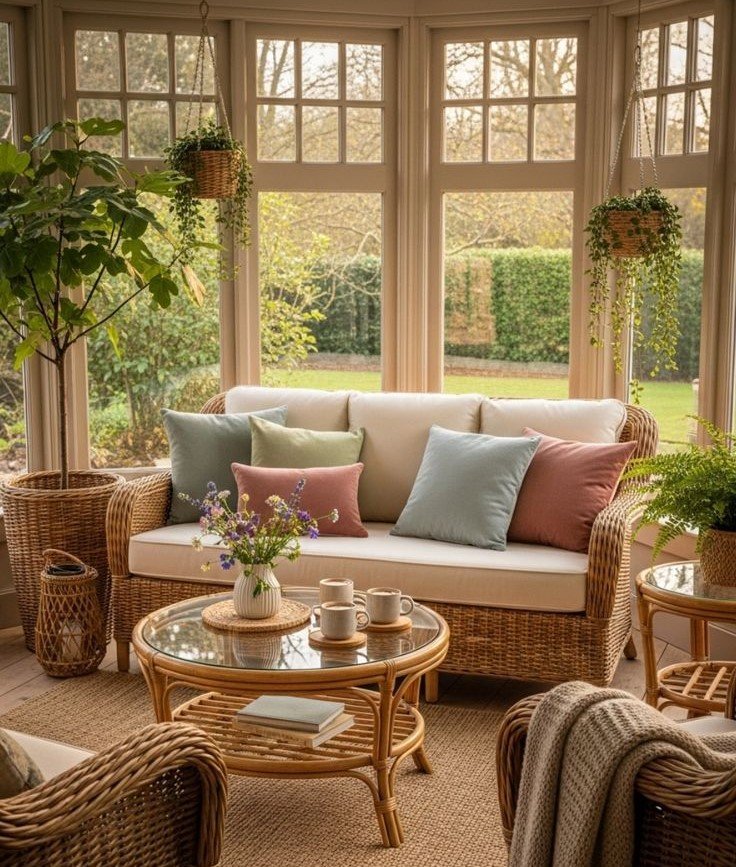
A sunroom’s financial performance depends on:
- Climate alignment
- Orientation awareness
- Glass specification
- Insulation integrity
- Energy cost context
When properly engineered, a sunroom can:
- Reduce seasonal energy waste
- Improve daily comfort
- Increase long-term property appeal
- Deliver measurable operating savings
When poorly specified, it becomes a recurring expense.
System thinking determines outcome.
FAQ Section
What is the difference between a sunroom and a conservatory?
A conservatory is typically more ornate and glass-dominant, often with glass roofing. A sunroom may have mixed roofing and modern insulation.
Can a sunroom be used year-round?
Yes, if built as a 4-season insulated structure with HVAC integration.
Do sunrooms increase home value?
High-quality 4-season sunrooms often increase buyer appeal and usable square footage perception.
Does a sunroom need insulation?
Yes. Without insulation, temperature swings are extreme.
What is the biggest mistake in sunroom design?
Choosing glass based on price instead of climate and orientation.








0 Comments